SACRED, BEAUTIFUL, & UNIVERSAL: Colloquium XIX from Corpus Christi Watershed on Vimeo.
Showing posts with label chant. Show all posts
Showing posts with label chant. Show all posts
Thursday, February 11, 2010
Monday, September 28, 2009
Chant photos


Here's a link to my Facebook photo album of the CMAA Gregorian chant pilgrimage I attended at the National Basilica Shrine of the Immaculate Conception in Washington, DC, this past weekend.
Wednesday, August 12, 2009
Gregorian Chant Pilgrimage to DC
On September 25-26, I'll be down in Washington, DC, at the National Basilica Shrine of the Immaculate Conception, for the Church Music Association of America's fall Gregorian chant pilgrimage.
Friday, September 25
12:30pm – 1:30pm: Registration @ JPII Center
1:30pm – 1:45pm: Welcome @ JPII Center Auditorium
1:45pm – 2:45pm: Chant rehearsal @ JPII Center Auditorium
2:45pm – 3:00pm: Break
3:15pm – 4:30pm: Chant rehearsal @ National Shrine, Upper Church, Blessed Sacrament Chapel
4:45pm – 6:00pm: Reception @ JP II Center, Rotunda
Dinner on your own
Saturday, September 26
9:00am – 9:30am: Coffee and Pastries @ JPII Center Auditorium
9:30am – 10:45am: Chant rehearsal @ JPII Center Auditorium
10:45am – 11:00am: BREAK
11:00am – 12:00pm: Chant rehearsal @ JPII Auditorium
12:00pm – 12:45pm: Catered Lunch @ JPII cafe
1:00pm – 1:45pm: Lecture: “Active Participation and Listening to Chant,” Dr. William Mahrt @ JPII Auditorium
2:00pm – 3:45pm: Chant rehearsal @ National Shrine, Crypt Church
3:45pm – 4:00pm: BREAK
4:15pm: Recitation of the Rosary @ National Shrine, Upper Church, Blessed Sacrament Chapel
5:00 pm – Mass in the Extraordinary Form @ National Shrine, Crypt Church
Friday, September 25
12:30pm – 1:30pm: Registration @ JPII Center
1:30pm – 1:45pm: Welcome @ JPII Center Auditorium
1:45pm – 2:45pm: Chant rehearsal @ JPII Center Auditorium
2:45pm – 3:00pm: Break
3:15pm – 4:30pm: Chant rehearsal @ National Shrine, Upper Church, Blessed Sacrament Chapel
4:45pm – 6:00pm: Reception @ JP II Center, Rotunda
Dinner on your own
Saturday, September 26
9:00am – 9:30am: Coffee and Pastries @ JPII Center Auditorium
9:30am – 10:45am: Chant rehearsal @ JPII Center Auditorium
10:45am – 11:00am: BREAK
11:00am – 12:00pm: Chant rehearsal @ JPII Auditorium
12:00pm – 12:45pm: Catered Lunch @ JPII cafe
1:00pm – 1:45pm: Lecture: “Active Participation and Listening to Chant,” Dr. William Mahrt @ JPII Auditorium
2:00pm – 3:45pm: Chant rehearsal @ National Shrine, Crypt Church
3:45pm – 4:00pm: BREAK
4:15pm: Recitation of the Rosary @ National Shrine, Upper Church, Blessed Sacrament Chapel
5:00 pm – Mass in the Extraordinary Form @ National Shrine, Crypt Church
Wednesday, July 22, 2009
Gregorian Chant Pilgrimage in Washington, DC
This is excellent! Musica Sacra is organizing a Gregorian Chant workshop the last weekend of September in Washington, DC, at the National Basilica Shrine. I am going to try and keep my schedule clear!
Monday, June 01, 2009
Mass in the Extraordinary Form in Philadelphia, June 28th @ 3:00 PM
Update: I won't be able to make it. My wife and I are going up to Newport, RI that weekend for our second anniversary.
Well, Fr. Carey is hoping to have more of these in the future.
Well, Fr. Carey is hoping to have more of these in the future.
A traditional Latin Missa Cantata (Mass in the Extraordinary Form) has been scheduled for 3:00 PM on Sunday, June 28, 2009 in anticipation of the Feast of Sts. Peter and Paul at the Church of St. Paul, on Christian St. between 9th and 10th Sts. in South Philadelphia. (map)It's been a while since I've been to the E.F. I strongly encourage people to come and pray!
Parking will be available across the street from the church. The church, which is very close to the 9th St. Italian Market, is readily accessible via SEPTA.
The music director for this TLM will be Nicholas Beck who is Music Director at Mater Ecclesiae in Berlin, NJ. Robert Ridgell will be the organist.
Father Gerald Carey, the Pastor of St. Paul Parish, will celebrate the Mass. The proper of the Mass will be sung in Gregorian chant. The Mass setting will be the familiar Missa de Angelis sung by the choir and the congregation.
Special polyphonic motets will be sung at the Offertory and at Holy Communion.
Our Sovereign Pontiff Pope Benedict XVI has made available a Plenary Indulgence for those who celebrate this Jubilee Year of St. Paul by participation in such a solemn celebration in connection with the Feast of Sts. Peter and Paul.
Friday, April 10, 2009
Christmas and the Crucifixion
At Christmas, we sing Venite, adoremus! ("Come, let us adore him.")
On Good Friday, in response to Ecce lignum Crucis, in quo salus mundi pependit ("Behold the wood of the Cross, on which hung the salvation of the world"), we sing Venite, adoremus! (Come, let us worship.")
Coincidence? I think not.
On Good Friday, in response to Ecce lignum Crucis, in quo salus mundi pependit ("Behold the wood of the Cross, on which hung the salvation of the world"), we sing Venite, adoremus! (Come, let us worship.")
Coincidence? I think not.
Thursday, March 12, 2009
Lenten Laments in English: Parce, Domine
Here is my attempt at a decent translation of Parce, Domine which retains the melody of the Latin chant.
R. Spare Thy people, Lord; spare us, Lord, we kneel here before Thee: lest Thy anger stay upon us forever.
1. To our knees we fall before Thy wrath, weeping tears of true contrition; crying out in supplication, we call to Thee with sorrowful hearts.
2. By our sins we have offended Thee, transgressing upon Thy mercy; pour down upon us from on high Thy gracious pardon, merciful One.
3. Cleanse the off'ring of our hearts, O Lord, in our tears and Thy charity: now is the day of salvation, now is a most acceptable time.
4. O benign Creator hear our prayers, bend Thine ear to our lamentations, in this season of penitence, this holy Lent of forty days.
5. O, beloved searcher of the heart, Thou Who knowest ev'ry weakness; grant Thy grace of forgiveness to those returning unto Thee.
R. Spare Thy people, Lord; spare us, Lord, we kneel here before Thee: lest Thy anger stay upon us forever.
1. To our knees we fall before Thy wrath, weeping tears of true contrition; crying out in supplication, we call to Thee with sorrowful hearts.
2. By our sins we have offended Thee, transgressing upon Thy mercy; pour down upon us from on high Thy gracious pardon, merciful One.
3. Cleanse the off'ring of our hearts, O Lord, in our tears and Thy charity: now is the day of salvation, now is a most acceptable time.
4. O benign Creator hear our prayers, bend Thine ear to our lamentations, in this season of penitence, this holy Lent of forty days.
5. O, beloved searcher of the heart, Thou Who knowest ev'ry weakness; grant Thy grace of forgiveness to those returning unto Thee.
Thursday, March 05, 2009
Lenten Lament: Attende, Domine
R. Attende, Domine, et miserere: quia peccavimus tibi.
(Hear us, O Lord, and have mercy: because we have sinned against You.)
1. Ad te, Rex summe, omnium Redemptor, oculos nostros sublevamus flentes: exaudi, Christe, supplicantum preces.
(To you, Most High King, Redeemer of us all, we lift our eyes, weeping: hear, O Christ, our prayers of supplication.)
2. Dextera Patris, lapis angularis, via salutis, ianua caelestis, ablue nostri maculas delicti.
([You are] at the right hand of the Father, the Corner-stone, the Way of Salvation, the Doorway to Heaven: blot out the stains of our sins.)
3. Rogamus, Deus, tuam maiestatem: auribus sacris gemitus exaudi: crimina nostra placidus indulge.
(We ask Your Majesty, O God: hear [our] groans with [Your] holy ears: graciously pardon our offenses.)
4. Tibi fatemur crimina admissa: contrito corde pandimus occulta: tua Redemptor, pietas ignoscat.
(To You we confess [our] consented sins: we disclose [our] hidden [sins] with contrine heart: O Redeemer, may your mercy forgive [them/us]!)
5. Innocens captus, nec repugnans ductus, testibus falsis pro impiis damnatus: quos redemisti, tu conserva, Christe.
(Innocent, held captive; not fighting back, lead forth; condemned by false witnesses, for [the sake of] the wicked: O Christ, keep safe those whom you have saved.)
In verse 5, the clause testibus falsis pro impiis damnatus can be translated a number of ways, including "condemned by false witnesses in the midst of the wicked" (wicked = Pharisees, etc.) and "condemned as the wicked [are condemned], by false witnesses" (wicked = sinners in general).
Next week, I'll work on producing "nice" translations (i.e. ones that roll of the tongue more easily) of Parce, Domine and Attende, Domine.
(Hear us, O Lord, and have mercy: because we have sinned against You.)
1. Ad te, Rex summe, omnium Redemptor, oculos nostros sublevamus flentes: exaudi, Christe, supplicantum preces.
(To you, Most High King, Redeemer of us all, we lift our eyes, weeping: hear, O Christ, our prayers of supplication.)
2. Dextera Patris, lapis angularis, via salutis, ianua caelestis, ablue nostri maculas delicti.
([You are] at the right hand of the Father, the Corner-stone, the Way of Salvation, the Doorway to Heaven: blot out the stains of our sins.)
3. Rogamus, Deus, tuam maiestatem: auribus sacris gemitus exaudi: crimina nostra placidus indulge.
(We ask Your Majesty, O God: hear [our] groans with [Your] holy ears: graciously pardon our offenses.)
4. Tibi fatemur crimina admissa: contrito corde pandimus occulta: tua Redemptor, pietas ignoscat.
(To You we confess [our] consented sins: we disclose [our] hidden [sins] with contrine heart: O Redeemer, may your mercy forgive [them/us]!)
5. Innocens captus, nec repugnans ductus, testibus falsis pro impiis damnatus: quos redemisti, tu conserva, Christe.
(Innocent, held captive; not fighting back, lead forth; condemned by false witnesses, for [the sake of] the wicked: O Christ, keep safe those whom you have saved.)
In verse 5, the clause testibus falsis pro impiis damnatus can be translated a number of ways, including "condemned by false witnesses in the midst of the wicked" (wicked = Pharisees, etc.) and "condemned as the wicked [are condemned], by false witnesses" (wicked = sinners in general).
Next week, I'll work on producing "nice" translations (i.e. ones that roll of the tongue more easily) of Parce, Domine and Attende, Domine.
Thursday, February 26, 2009
Lenten Lament: Attende Domine
Next Wednesday, I'll post another Lenten favorite of mine, Attende Domine ("Hear [us] Lord"). This and Parce Domine are two of the earliest chants I learned (all of 18 months ago). They are simple melodies to learn, certainly penitential in character, and the words could not be truer. The Latin is beautiful, and it doesn't hurt to know what it means in English either!
Here's a teaser for Attende Domine:
R. Attende, Domine, et miserere: quia peccavimus tibi.
(Hear us, O Lord, and have mercy: because we have sinned against You.)
1. Ad te, Rex summe, omnium Redemptor, oculos nostros sublevamus flentes: exaudi, Christe, supplicantum preces.
(To you, Most High King, Redeemer of us all, we lift our eyes, weeping: hear, O Christ, our prayers of supplication.)
That's enough for now. Meditate on those words (and the words of Parce Domine) during Lent, especially on Friday.
As part of your penance (or mine?) I plan on recording myself singing this and Parce Domine and placing it online.
Here's a teaser for Attende Domine:
R. Attende, Domine, et miserere: quia peccavimus tibi.
(Hear us, O Lord, and have mercy: because we have sinned against You.)
1. Ad te, Rex summe, omnium Redemptor, oculos nostros sublevamus flentes: exaudi, Christe, supplicantum preces.
(To you, Most High King, Redeemer of us all, we lift our eyes, weeping: hear, O Christ, our prayers of supplication.)
That's enough for now. Meditate on those words (and the words of Parce Domine) during Lent, especially on Friday.
As part of your penance (or mine?) I plan on recording myself singing this and Parce Domine and placing it online.
Wednesday, February 25, 2009
Lenten Lament: Parce Domine
R. Parce Domine, parce populo tuo: ne in aeternum irascaris nobis.
(Spare, O Lord, spare Your people: lest You be angry with us forever.)
1. Flectamus iram vindicem, ploremus ante Judicem; clamemus ore supplici, dicamus omnes cernui.
(Let us bow before the avenging wrath, let us weep before the Judge; let us cry out with words of supplication, let us all speak, falling prostrate.)
2. Nostris malis offendimus tuam Deus clementiam; effunde nobis desuper remissor indulgentiam.
(O God, by our wickedness we have offended Your clemency; pour forth on us from above, O forgiving One, Your pardon.)
3. Dans tempus acceptabile, da lacrimarum rivulis lavare cordis victimam, quam laeta adurat caritas.
(Giving us an acceptable time, grant to purify, in the rivers of our tears, the sacrifice of our hearts, enkindled by joyful charity.)
4. Audi, benigne Conditor, nostras preces cum fletibus in hoc sacro jejunio fusas quadragenario.
(Hear, O benign Creator, our prayers, with lamentations, poured forth during this holy fast of forty days.)
5. Scrutator alme cordium, infirma tu scis virium; ad te reversis exhibe remissionis gratiam.
(O beloved searcher of hearts, You know the weakness of mortal bodies; show to those returning to You the grace of forgiveness.)
English translations are essentially my own. Verse 3 was a tough one.
The antiphon is based on Joel 2:17.
Verse 1 is from Ex more docti mystico (Pope St. Gregory I), verse 5 (according to the revision by Pope Urban VIII). Verse 2 is from Ex more docti mystico, verse 6 (original).
Verse 3 is from O Sol salutis initimis (Pope Urban VIII), verse 2 (revision of Iam, Christe, sol iustitiae).
Verses 4 and 5 are from Audi, benigne Conditor (Pope St. Gregory I), verses 1 and 2.
(Spare, O Lord, spare Your people: lest You be angry with us forever.)
1. Flectamus iram vindicem, ploremus ante Judicem; clamemus ore supplici, dicamus omnes cernui.
(Let us bow before the avenging wrath, let us weep before the Judge; let us cry out with words of supplication, let us all speak, falling prostrate.)
2. Nostris malis offendimus tuam Deus clementiam; effunde nobis desuper remissor indulgentiam.
(O God, by our wickedness we have offended Your clemency; pour forth on us from above, O forgiving One, Your pardon.)
3. Dans tempus acceptabile, da lacrimarum rivulis lavare cordis victimam, quam laeta adurat caritas.
(Giving us an acceptable time, grant to purify, in the rivers of our tears, the sacrifice of our hearts, enkindled by joyful charity.)
4. Audi, benigne Conditor, nostras preces cum fletibus in hoc sacro jejunio fusas quadragenario.
(Hear, O benign Creator, our prayers, with lamentations, poured forth during this holy fast of forty days.)
5. Scrutator alme cordium, infirma tu scis virium; ad te reversis exhibe remissionis gratiam.
(O beloved searcher of hearts, You know the weakness of mortal bodies; show to those returning to You the grace of forgiveness.)
English translations are essentially my own. Verse 3 was a tough one.
The antiphon is based on Joel 2:17.
Verse 1 is from Ex more docti mystico (Pope St. Gregory I), verse 5 (according to the revision by Pope Urban VIII). Verse 2 is from Ex more docti mystico, verse 6 (original).
Verse 3 is from O Sol salutis initimis (Pope Urban VIII), verse 2 (revision of Iam, Christe, sol iustitiae).
Verses 4 and 5 are from Audi, benigne Conditor (Pope St. Gregory I), verses 1 and 2.
Sunday, December 14, 2008
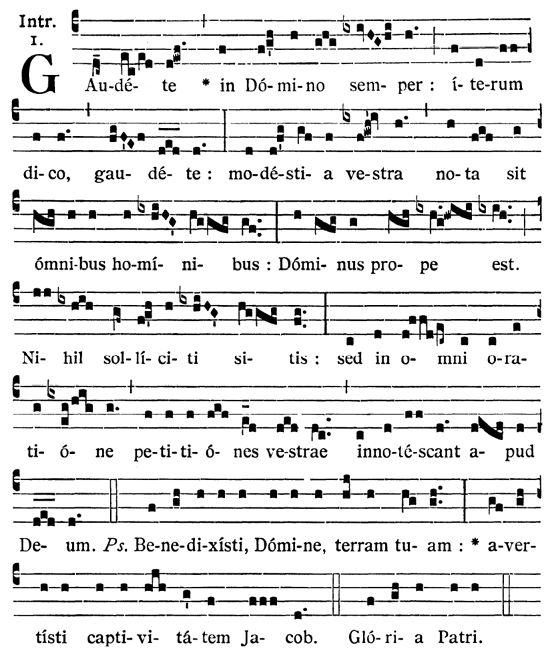
Music: Gaudete introit for the 3rd Sunday of Advent
Gaudete in Domino semper; iterum dico: Gaudete!
Modestia vestra nota sit hominibus. Dominus prope est.
Nihil solliciti sitis, sed in omni oratione petitiones vestrae innotescant apud Deum.
(Phil 4:4-6)
Benedixisti, Domine, terram tuam. Avertisti captivitatem Jacob.
(Ps 84:2 / 85:1)
Gloria Patri et Filio et Spiritui Sancto.
Sicut erat in principiem, et nunc, et semper, et in saecula saeculorum, amen.
"Rejoice in the Lord always; I say again: Rejoice!"
Lest we forget!

Modestia vestra nota sit hominibus. Dominus prope est.
Nihil solliciti sitis, sed in omni oratione petitiones vestrae innotescant apud Deum.
(Phil 4:4-6)
Benedixisti, Domine, terram tuam. Avertisti captivitatem Jacob.
(Ps 84:2 / 85:1)
Gloria Patri et Filio et Spiritui Sancto.
Sicut erat in principiem, et nunc, et semper, et in saecula saeculorum, amen.
"Rejoice in the Lord always; I say again: Rejoice!"
Lest we forget!
|
Saturday, December 06, 2008
So much sacred music!
In the past month, I have received as gifts a few excellent CDs of sacred music. I'd like to share them with you.
From Branson, for whom I am an RCIA sponsor, I received "Stella Maris" by Trio Mediaeval as a birthday present. This CD has several 12th and 13th century polyphonic pieces (including two odes to the Blessed Virigin Mary) and a contempory polyphonic Mass setting (Missa Lumen de Lumine) by Korean composer Sungji Hong.
From the Benedictines of Mary, Queen of Apostles, I received "Echoes of Ephesus" in the mail. It has two dozen pieces of chant and polyphony (in both English and Latin), including some contemporary pieces. You can definitely detect the devotion of these women -- to God and to sacred music which praises Him and His saints!
And from the Wyoming Catholic College Choir, I received "Christmas In God's Country" in the mail. It has just shy of two dozen pieces of chant and polyphony (in both English and Latin), including one of my recent favorites, Angelus ad Virginem! The choirmaster is none other than Dr. Peter A. Kwasniewski, the author of several articles on sacred music and liturgy ("Aspects of the Liturgical Magisterium", Parts I, II, and III; "Extraordinary Ministers of the Eucharist" [since clarified as "... of Holy Communion"] at EWTN).
Consider purchasing these beautiful CDs of beautiful sacred music. I don't think you'll be disappointed.
From Branson, for whom I am an RCIA sponsor, I received "Stella Maris" by Trio Mediaeval as a birthday present. This CD has several 12th and 13th century polyphonic pieces (including two odes to the Blessed Virigin Mary) and a contempory polyphonic Mass setting (Missa Lumen de Lumine) by Korean composer Sungji Hong.
From the Benedictines of Mary, Queen of Apostles, I received "Echoes of Ephesus" in the mail. It has two dozen pieces of chant and polyphony (in both English and Latin), including some contemporary pieces. You can definitely detect the devotion of these women -- to God and to sacred music which praises Him and His saints!
And from the Wyoming Catholic College Choir, I received "Christmas In God's Country" in the mail. It has just shy of two dozen pieces of chant and polyphony (in both English and Latin), including one of my recent favorites, Angelus ad Virginem! The choirmaster is none other than Dr. Peter A. Kwasniewski, the author of several articles on sacred music and liturgy ("Aspects of the Liturgical Magisterium", Parts I, II, and III; "Extraordinary Ministers of the Eucharist" [since clarified as "... of Holy Communion"] at EWTN).
Consider purchasing these beautiful CDs of beautiful sacred music. I don't think you'll be disappointed.
Thursday, December 04, 2008
Sacred Music in three minutes
Please take the time to watch this video. At least think about what it says!
Thursday, February 28, 2008
Music: Memorare chant
I have absolutely no training whatsoever in chant, so I'm sure I'm going to butcher this project (when I get around to it), but I have half a mind to compose a Gregorian chant of the Memorare. I think it would be Hypolydian (Mode VI) which is classified as "devout" (D'Arezzo), "pious" (Fulda), and "tearful and pious" (Espinoza).
MEMORARE, O piissima Virgo Maria,
non esse auditum a saeculo, quemquam ad tua currentem praesidia,
tua implorantem auxilia, tua petentem suffragia,
esse derelictum.
Ego tali animatus confidentia,
ad te, Virgo Virginum, Mater, curro,
ad te venio, coram te gemens peccator assisto.
Noli, Mater Verbi,
verba mea despicere;
sed audi propitia et exaudi.
Amen.
Sunday, January 06, 2008
Liturgy: Chanting the prayers
So Fr. Aidan, a Vincentian priest from the nearby seminary, celebrated the 8:45 Mass this morning for the Solemnity of the Epiphany. He used the Roman Canon (which pleased me) but he also chanted the Collect, the Super Oblata, and the Post Communionem. However, the congregation was apparently shocked out of their minds. The "Amen" response the first two times was horrendous! (How hard is it to chant "A-men"? It's just one note!) The third time, we did better (because Fr. Aidan lowered the key).
Speaking with him after Mass, he said he decided not to chant the dialogue at the beginning of the Liturgy of the Eucharist ("The Lord be with you", "And also with you", etc.) because he feared we would not know the tune to respond with. How sad it is that most of my parish doesn't know this primary form of actual participation! Missalettes and hymnals should include more standard music for the Order of Mass. You usually only see tunes for the Kyrie and the Gloria and other parts that people "expect" to be sung, rather than for the whole Ordinary of Mass.
Speaking with him after Mass, he said he decided not to chant the dialogue at the beginning of the Liturgy of the Eucharist ("The Lord be with you", "And also with you", etc.) because he feared we would not know the tune to respond with. How sad it is that most of my parish doesn't know this primary form of actual participation! Missalettes and hymnals should include more standard music for the Order of Mass. You usually only see tunes for the Kyrie and the Gloria and other parts that people "expect" to be sung, rather than for the whole Ordinary of Mass.
Friday, December 21, 2007
Podcast: Chanting the Solemn Blessing (TCR-001)
[The chant at the opening and closing of this podcast is Sanctus VIII (Missa de Angelis) from the CD O Lux Beatissima (A Treasury of Gregorian Chant), by Cantores in Ecclesia. I bought it via iTunes.]
"Chanting the Solemn Blessing" (7:28)
This is my first podcast, so I'm sorry if the audio quality isn't great. I don't have a sophisticated setup here... I have a dinky little microphone, a piece of software called Sound Forge Audio Studio 8.0 (which I'm sure I'm not using to its utmost potential), and I'm really a beginner at this.
In this inaugural podcast, I will be chanting (probably an octave lower than normal) the Solemn Blessing for Christmas in both tones provided for in the Sacramentary, Appendix III - Music for the Order of Mass (pages 1045-1048). The Sacramentary provides the models for the Solemn Blessing, although it is not always clear which texts are one phrase, two phrases, or three phrases. I will be treating the Solemn Blessing for Christmas as being made up of three texts: the first two have two phrases, and the last one has three phrases.
The character ÿ is supposed to be a y with a grave accent (`) over it, but I can't seem to find that character code. A syllable with a grave accent (`) over it means the tone drops; a syllable with an acute accent (´) over it means the tone rises. Those syllables are also in bold. Syllables in italics are held longer.
The text I use is the Solemn Blessing for Christmas, found on page 570 of the Sacramentary. Tone A's dominant note is a C.
Tone B is a little more complicated, because the final three words of a text have modulation on them. Tone B's dominant note is a A.
You'll notice that Tone A is simpler than Tone B, both for the priest and the congregation. Regardless of which tone you (as the priest) decide to use, you should certainly make sure your congregation knows how to respond. You could have your cantor prepare them before the opening hymn, for instance.
I look forward to your comments, suggestions, or questions. Remember, I'm not a priest, I'm not a professionally trained liturgist, I'm just a layman in the Church with a growing interest in chant and solemn celebration of the Holy Sacrifice of the Mass. Benedicite!
"Chanting the Solemn Blessing" (7:28)
This is my first podcast, so I'm sorry if the audio quality isn't great. I don't have a sophisticated setup here... I have a dinky little microphone, a piece of software called Sound Forge Audio Studio 8.0 (which I'm sure I'm not using to its utmost potential), and I'm really a beginner at this.
In this inaugural podcast, I will be chanting (probably an octave lower than normal) the Solemn Blessing for Christmas in both tones provided for in the Sacramentary, Appendix III - Music for the Order of Mass (pages 1045-1048). The Sacramentary provides the models for the Solemn Blessing, although it is not always clear which texts are one phrase, two phrases, or three phrases. I will be treating the Solemn Blessing for Christmas as being made up of three texts: the first two have two phrases, and the last one has three phrases.
The character ÿ is supposed to be a y with a grave accent (`) over it, but I can't seem to find that character code. A syllable with a grave accent (`) over it means the tone drops; a syllable with an acute accent (´) over it means the tone rises. Those syllables are also in bold. Syllables in italics are held longer.
The text I use is the Solemn Blessing for Christmas, found on page 570 of the Sacramentary. Tone A's dominant note is a C.
As the audio shows, "Spirit" has three notes -- the first syllable has two notes (C-A), and the second syllable has one note (A) -- which is why I have the first syllable underlined.Tone A
[2 phrases]
When he came to us as man,
the Son of God scattered the darkness of this world,
and filled this holy night (day) with his glóry.
May the God of infinite goodness
scatter the darkness of sin
and brighten your hearts with hòliness. (Amen)
[2 phrases]
God sent his angels to shepherds
to herald the great joy of our Savior's bírth.
May he fill you with joy
and make you heralds of his gòspel. (Amen)
[3 phrases]
When the Word became man,
earth was joined tò héaven.
May he give you his peace and good wíll,
and fellowship with all the heavenly hòst. (Amen)
May almightÿ Gòd bléss you,
the Father ànd thè Són, and the Holy Spìrit. (Amen)

Tone B is a little more complicated, because the final three words of a text have modulation on them. Tone B's dominant note is a A.
The first syllable of "Spirit" has two notes again, thus the underlining.Tone B
[2 phrases]
When he came to us as man,
the Son of God scattered the darkness of this world,
and filled this holy night (day) with his glóry.
May the God of infinite goodness
scatter the darkness of sin
and brighten your hèarts wíth hòliness. (Amen)
[2 phrases]
God sent his angels to shepherds
to herald the great joy of our Savior's bírth.
May he fill you with joy
and make you heralds òf hís gòspel. (Amen)
[3 phrases]
When the Word became man,
earth was joined to hèaven.
May he give you his peace and good wíll,
and fellowship with all thè héavenly hòst. (Amen)
May almíghty God blèss you,
the Fáther and the Són, ànd the Hòlý Spìrit. (Amen)

You'll notice that Tone A is simpler than Tone B, both for the priest and the congregation. Regardless of which tone you (as the priest) decide to use, you should certainly make sure your congregation knows how to respond. You could have your cantor prepare them before the opening hymn, for instance.
I look forward to your comments, suggestions, or questions. Remember, I'm not a priest, I'm not a professionally trained liturgist, I'm just a layman in the Church with a growing interest in chant and solemn celebration of the Holy Sacrifice of the Mass. Benedicite!
Tuesday, December 04, 2007
Liturgy: Solemn Blessings should be chanted
Have you ever been at a Mass which ended with a Solemn Blessing? This is when the deacon or (in his absence) the priest says: "Bow your heads and pray for God's blessing." The priest then says a blessing with multiple parts, and the congregation responds "Amen" after each.
Of course... the congregation has their heads bowed, so they're looking at their folded hands, the back of the pew in front of them, or the floor. This means, even if the priest or deacon makes some sort of gesture signaling their response, they won't see it. Often people don't know when the phrase the priest is saying has ended. How can we resolve this?
Chant the Solemn Blessing. This is my request.
If you're a priest reading this blog, and you plan on using a Solemn Blessing (since the Sacramentary provides such blessings for Advent, Christmas, the New Year, the Epiphany, the Passion, the Easter Vigil, Easter Sunday, Paschaltide, the Ascension, and numerous other occasions), please, please consider chanting it. (If you're not a priest, please suggest this to your priests, or at least to your pastor. Refer them to this post.)
How can you do this, you ask? Well, the Sacramentary, in Appendix III - Music for the Order of Mass, on pages 1045-1047, provides two models for chanting the Solemn Blessing. For each of these two models it provides an example using the Solemn Blessing for Advent. Spend some time with it. If you use the same setting (A or B), your congregation simply needs to know the tunes for "And also with you" and "Amen", which are very simple.
I might provide audio clips, if the Spirit moves me.
Of course... the congregation has their heads bowed, so they're looking at their folded hands, the back of the pew in front of them, or the floor. This means, even if the priest or deacon makes some sort of gesture signaling their response, they won't see it. Often people don't know when the phrase the priest is saying has ended. How can we resolve this?
Chant the Solemn Blessing. This is my request.
If you're a priest reading this blog, and you plan on using a Solemn Blessing (since the Sacramentary provides such blessings for Advent, Christmas, the New Year, the Epiphany, the Passion, the Easter Vigil, Easter Sunday, Paschaltide, the Ascension, and numerous other occasions), please, please consider chanting it. (If you're not a priest, please suggest this to your priests, or at least to your pastor. Refer them to this post.)
How can you do this, you ask? Well, the Sacramentary, in Appendix III - Music for the Order of Mass, on pages 1045-1047, provides two models for chanting the Solemn Blessing. For each of these two models it provides an example using the Solemn Blessing for Advent. Spend some time with it. If you use the same setting (A or B), your congregation simply needs to know the tunes for "And also with you" and "Amen", which are very simple.
I might provide audio clips, if the Spirit moves me.
Monday, November 05, 2007
Music: Three sheets of Gregorian Chant
The New Liturgical Movement is also watching this.
[Update: thanks to the helpful comments below (and at NLM), I'll be expanding this blog post to include the explanations for the "incomplete" parts of the sheets (such as versicles that seem to stop mid-word).]
Below you'll find images of three double-sided sheets of vellum with Gregorian Chant. I bought them at the Golden Nugget antique market (just outside Lambertville, NJ) this past Sunday, for a mere $150. They measure about 20" by 11" and are in varying states of disrepair.
Sheet 1A-B
The drifting et clamate at the beginning of this page will be explained later. The front of the first sheet includes references to Isaiah 7:14 (Ecce, virgo concipiet), Isaiah 9:6 (Admirabilis deus), Isaiah 9:7 (Super solium), and Exodus 4:13 (Obsecro inquit), and then a text I cannot find in the Bible (vide afflictionem) which continues to the back of the sheet.
 ... et clamate. V. Salva: R. Ecce
virgo concipiet et pariet filium dici-
t dominus et vocabitur nomen eiu-
s. ?. admirabilis deus fortis: ?.
Super solium david et super re-
gnum eius sedebit in eternum.
?. admi: R. Obsecro inquit domine
mitte quem missurus es vide affli...
The back of the first sheet completes the phrase from the front. It also contains a reference to Psalm 105[104]:4 (Memento nostri) and Isaiah 49:13 (Laetentur caeli).
 ...ctionem populi tui. R. Sicut locu-
tus es veni et libera nos. V. Me-
mento nostri domine in beneplacito
populi tui visita nos in salutari tu-
o. R. Sicut: ????? Allelu-
ya alleluya alleluya: seculo?:
Laetentur celi et exultet
terra jubilate montes laudem quia...
Sheet 2A-B
This sheet has larger margins than sheets one and three, so I suspect it is from a completely different manuscript. I can tell the front from the back because of a few clues. The first image (the front) has an F-clef and is clearly continuing from some other page, whereas the second image (the back) has a C-clef at the bottom and is finished with its last word. In addition, the first image (the front) has a C-clef at the bottom, and the custos -- the fragment of a neume (or note) at the end of a staff -- is a "C", which matches with the leading "C" neume of the second image (the back). This page appears to be part of a requiem.
The front has three initials in the upper-right corner (SLO or JLO). The text starts by completing what I assume is an alleluya. Then it refers to Sirach 45:9 (Induit eos dominus) and the apocryphal work 4 Ezra 2:35 (Lux perpetua lucebit).
 ...luya. V. Induit eos
dominus stola glorie et corona-
vit eos. P. Indie. R. Lux
perpetua lucebit sanctis tuis do-
mine et eternitas tem-
porum alleluya alleluya.
The back begins with Psalm 117[116]:15 (Vox exultationis) followed by a reference to Revelation 11:4 (Isti sunt due olive). The last word on the page is Habent (with the n omitted) which is the continuation of the antiphon (habent potestatem claudere...).
 Vox exultationis et
salutis in tabernaculis iu-
storum. P. Et eter. R. Isti sunt
due olive et duo candela-
bra lucencia ante
dominum alleluya. Habent...
Sheet 3A-B
Given the wear at the bottom-right corner of the first image, I've assumed that's the front. It (the front) begins with a fragment of Luke 1:34 (virum non cognosco, Mary speaking to the angel Gabriel); in the middle there is a brief excerpt of Micah 1:3 (Domino egredietur) followed by Philippians 3:20-21 (Salvatorum expectamus); it ends with Titus 2:12-13 (Sobrie et iuste et pie) which is continued on the back side (vivamus in hoc seculo).
 ... virum non cognosco et respondens
angelus dixit ei R. Spiri:
In secdo noctno ?? alla? Domino. V. Egredietur Do.
Salvatorum expectamus
dominum ihesum xristum qui reform*a-
bit corpus humilitatis nostre confi-
guratum corpori claritatis
sue: V. Sobrie et iuste et pie...
The back refers to Jeremiah 31:10 (Audite verbum domini gentes) and has the phrase Salvator noster adveniet; it concludes with Jeremiah 4:5 (Annunciate et auditum facite loquimini). From what Google has told me, the next two words of this phrase should be... et clamate! Which are the words on the first page I deciphered! I have two consecutive sheets!
 ...vivamus in hoc seculo expectantes bea-
tum spem et adventum glorie ma-
gni dei: qui refor*. R. Audite
verbum domini gentes et annuncia-
te illud in finibus terre et in in-
sulis que procul sunt dicite: P. Salvator
noster adveniet. V. Annun-
ciate et auditum facite loquimini...
[Update: thanks to the helpful comments below (and at NLM), I'll be expanding this blog post to include the explanations for the "incomplete" parts of the sheets (such as versicles that seem to stop mid-word).]
Below you'll find images of three double-sided sheets of vellum with Gregorian Chant. I bought them at the Golden Nugget antique market (just outside Lambertville, NJ) this past Sunday, for a mere $150. They measure about 20" by 11" and are in varying states of disrepair.
Sheet 1A-B
The drifting et clamate at the beginning of this page will be explained later. The front of the first sheet includes references to Isaiah 7:14 (Ecce, virgo concipiet), Isaiah 9:6 (Admirabilis deus), Isaiah 9:7 (Super solium), and Exodus 4:13 (Obsecro inquit), and then a text I cannot find in the Bible (vide afflictionem) which continues to the back of the sheet.
 ... et clamate. V. Salva: R. Ecce
virgo concipiet et pariet filium dici-
t dominus et vocabitur nomen eiu-
s. ?. admirabilis deus fortis: ?.
Super solium david et super re-
gnum eius sedebit in eternum.
?. admi: R. Obsecro inquit domine
mitte quem missurus es vide affli...
The back of the first sheet completes the phrase from the front. It also contains a reference to Psalm 105[104]:4 (Memento nostri) and Isaiah 49:13 (Laetentur caeli).
 ...ctionem populi tui. R. Sicut locu-
tus es veni et libera nos. V. Me-
mento nostri domine in beneplacito
populi tui visita nos in salutari tu-
o. R. Sicut: ????? Allelu-
ya alleluya alleluya: seculo?:
Laetentur celi et exultet
terra jubilate montes laudem quia...
Sheet 2A-B
This sheet has larger margins than sheets one and three, so I suspect it is from a completely different manuscript. I can tell the front from the back because of a few clues. The first image (the front) has an F-clef and is clearly continuing from some other page, whereas the second image (the back) has a C-clef at the bottom and is finished with its last word. In addition, the first image (the front) has a C-clef at the bottom, and the custos -- the fragment of a neume (or note) at the end of a staff -- is a "C", which matches with the leading "C" neume of the second image (the back). This page appears to be part of a requiem.
The front has three initials in the upper-right corner (SLO or JLO). The text starts by completing what I assume is an alleluya. Then it refers to Sirach 45:9 (Induit eos dominus) and the apocryphal work 4 Ezra 2:35 (Lux perpetua lucebit).
 ...luya. V. Induit eos
dominus stola glorie et corona-
vit eos. P. Indie. R. Lux
perpetua lucebit sanctis tuis do-
mine et eternitas tem-
porum alleluya alleluya.
The back begins with Psalm 117[116]:15 (Vox exultationis) followed by a reference to Revelation 11:4 (Isti sunt due olive). The last word on the page is Habent (with the n omitted) which is the continuation of the antiphon (habent potestatem claudere...).
 Vox exultationis et
salutis in tabernaculis iu-
storum. P. Et eter. R. Isti sunt
due olive et duo candela-
bra lucencia ante
dominum alleluya. Habent...
Sheet 3A-B
Given the wear at the bottom-right corner of the first image, I've assumed that's the front. It (the front) begins with a fragment of Luke 1:34 (virum non cognosco, Mary speaking to the angel Gabriel); in the middle there is a brief excerpt of Micah 1:3 (Domino egredietur) followed by Philippians 3:20-21 (Salvatorum expectamus); it ends with Titus 2:12-13 (Sobrie et iuste et pie) which is continued on the back side (vivamus in hoc seculo).
 ... virum non cognosco et respondens
angelus dixit ei R. Spiri:
In secdo noctno ?? alla? Domino. V. Egredietur Do.
Salvatorum expectamus
dominum ihesum xristum qui reform*a-
bit corpus humilitatis nostre confi-
guratum corpori claritatis
sue: V. Sobrie et iuste et pie...
The back refers to Jeremiah 31:10 (Audite verbum domini gentes) and has the phrase Salvator noster adveniet; it concludes with Jeremiah 4:5 (Annunciate et auditum facite loquimini). From what Google has told me, the next two words of this phrase should be... et clamate! Which are the words on the first page I deciphered! I have two consecutive sheets!
 ...vivamus in hoc seculo expectantes bea-
tum spem et adventum glorie ma-
gni dei: qui refor*. R. Audite
verbum domini gentes et annuncia-
te illud in finibus terre et in in-
sulis que procul sunt dicite: P. Salvator
noster adveniet. V. Annun-
ciate et auditum facite loquimini...
Thursday, October 25, 2007
Music: Jubilate Deo!
The St. Cecilia Schola Cantorum has Jubilate Deo available for download in PDF and Word format. What is Jubilate Deo, you ask? Why, it's a product of Vatican II! Didn't anyone tell you?
Pope Paul VI had the Sacred Congregation for Divine Worship issue Jubilate Deo as a "personal gift" to the Catholic Bishops in 1974. It contains the "minimum repertoire of Gregorian chant" for the faithful, in accordance with Sacrosanctum Concilium, the Constitution on the Liturgy from Vatican II (Voluntati Obsequens).
Download it, print it out, read it, study it, learn it, love it! Introduce it to your pastor and your parish's musical director!
Pope Paul VI had the Sacred Congregation for Divine Worship issue Jubilate Deo as a "personal gift" to the Catholic Bishops in 1974. It contains the "minimum repertoire of Gregorian chant" for the faithful, in accordance with Sacrosanctum Concilium, the Constitution on the Liturgy from Vatican II (Voluntati Obsequens).
Download it, print it out, read it, study it, learn it, love it! Introduce it to your pastor and your parish's musical director!
Subscribe to:
Posts (Atom)