This Sunday afternoon, after watching the Giants trounce the Dolphins, I will be boarding a train to NYC, foregoing the evening match between the Cowboys and the Eagles, to have dinner with my brother and then see Godspell at the Circle in the Square on Broadway.
A few weeks ago I received an email from the promotions director of the theatrical company producing the musical, offering me two free tickets so long as I blog about it. And lately it seems like I need a motivation to blog about something! (Work and home life have kept me on my toes and off blogger.)
So on Monday or Tuesday, expect another post with my review and commentary on the new production of Godspell. (I was in a community production of it back in the late 90s, and I've been pretty fond of the musical since I first heard it, so I'm quite excited to see a new production of it.)
In the meantime, if you are in the NYC area and would like to get discounted tickets to the show, just go to http://tinyurl.com/GodspellBloggerDiscount, or go to Godspell.com and enter the promotional code GSPRD719 when you buy your tickets.
(And here's a mother's review of the show, writing from the perspective of a woman caring for an autistic daughter.)
Showing posts with label music. Show all posts
Showing posts with label music. Show all posts
Friday, October 28, 2011
Wednesday, July 27, 2011
Pius X, XI, and XII on congregational singing at Mass


Special efforts are to be made to restore the use of the Gregorian Chant by the people, so that the faithful may again take a more active part in the ecclesiastical offices, as was the case in ancient times. (Tra le sollecitudini, Pius X, 1903)
In order that the faithful may more actively participate in divine worship, let them be made once more to sing the Gregorian Chant, so far as it belongs to them to take part in it. It is most important that when the faithful assist at the sacred ceremonies, or when pious sodalities take part with the clergy in a procession, they should not be merely detached and silent spectators, but, filled with a deep sense of the beauty of the Liturgy, they should sing alternately with the clergy or the choir, as it is prescribed. If this is done, then it will no longer happen that the people either make no answer at all to the public prayers -- whether in the language of the Liturgy or in the vernacular -- or at best utter the responses in a low and subdued manner. (Divini Cultus, Pius XI, 1928)
Therefore, they are to be praised who, with the idea of getting the Christian people to take part more easily and more fruitfully in the Mass, strive to make them familiar with the "Roman Missal," so that the faithful, united with the priest, may pray together in the very words and sentiments of the Church. They also are to be commended who strive to make the liturgy even in an external way a sacred act in which all who are present may share. This can be done [...] in high Masses when they answer the prayers of the minister of Jesus Christ and also sing the liturgical chant. (Mediator Dei, Pius XII, 1947)
It is the duty of all those to whom Christ the Lord has entrusted the task of guarding and dispensing the Church's riches to preserve this precious treasure of Gregorian chant diligently and to impart it generously to the Christian people. [...] May it thus come about that the Christian people begin even on this earth to sing that song of praise it will sing forever in heaven. (Musicae Sacrae, Pius XII, 1955)
In solemn Mass there are three degrees of the participation of the faithful: a) First, the congregation can sing the liturgical responses. These are: Amen; Et cum spiritu tuo; Gloria tibi, Domine; Habemus ad Dominum; Dignum et justum est; Sed libera nos a malo; Deo gratias. Every effort must be made that the faithful of the entire world learn to sing these responses. b) Secondly, the congregation can sing the parts of the Ordinary of the Mass: Kyrie, eleison; Gloria in excelsis Deo; Credo; Sanctus-Benedictus; Agnus Dei. Every effort must be made that the faithful learn to sing these parts, particularly according to the simpler Gregorian melodies. But if they are unable to sing all these parts, there is no reason why they cannot sing the easier ones: Kyrie, eleison; Sanctus-Benedictus; Agnus Dei; the choir, then, can sing the Gloria, and Credo. In connection with this, the following Gregorian melodies, because of their simplicity, should be learned by the faithful throughout the world: the Kyrie, eleison; Sanctus-Benedictus; Agnus Dei of Mass XVI from the Roman Gradual; the Gloria in excelsis Deo, and Ite, missa est-Deo gratias of Mass XV; and either Credo I or Credo III. In this way it will be possible to achieve that most highly desirable goal of having the Christian faithful throughout the world manifest their common faith by active participation in the holy Sacrifice of the Mass, and by common and joyful song. c) Thirdly, if those present are well trained in Gregorian chant, they can sing the parts of the Proper of the Mass. This form of participation should be carried out particularly in religious congregations and seminaries. (De Musica Sacra, Sacred Congregation for Rites (during Pius XII), 1958)
In order that the faithful may more actively participate in divine worship, let them be made once more to sing the Gregorian Chant, so far as it belongs to them to take part in it. It is most important that when the faithful assist at the sacred ceremonies, or when pious sodalities take part with the clergy in a procession, they should not be merely detached and silent spectators, but, filled with a deep sense of the beauty of the Liturgy, they should sing alternately with the clergy or the choir, as it is prescribed. If this is done, then it will no longer happen that the people either make no answer at all to the public prayers -- whether in the language of the Liturgy or in the vernacular -- or at best utter the responses in a low and subdued manner. (Divini Cultus, Pius XI, 1928)
Therefore, they are to be praised who, with the idea of getting the Christian people to take part more easily and more fruitfully in the Mass, strive to make them familiar with the "Roman Missal," so that the faithful, united with the priest, may pray together in the very words and sentiments of the Church. They also are to be commended who strive to make the liturgy even in an external way a sacred act in which all who are present may share. This can be done [...] in high Masses when they answer the prayers of the minister of Jesus Christ and also sing the liturgical chant. (Mediator Dei, Pius XII, 1947)
It is the duty of all those to whom Christ the Lord has entrusted the task of guarding and dispensing the Church's riches to preserve this precious treasure of Gregorian chant diligently and to impart it generously to the Christian people. [...] May it thus come about that the Christian people begin even on this earth to sing that song of praise it will sing forever in heaven. (Musicae Sacrae, Pius XII, 1955)
In solemn Mass there are three degrees of the participation of the faithful: a) First, the congregation can sing the liturgical responses. These are: Amen; Et cum spiritu tuo; Gloria tibi, Domine; Habemus ad Dominum; Dignum et justum est; Sed libera nos a malo; Deo gratias. Every effort must be made that the faithful of the entire world learn to sing these responses. b) Secondly, the congregation can sing the parts of the Ordinary of the Mass: Kyrie, eleison; Gloria in excelsis Deo; Credo; Sanctus-Benedictus; Agnus Dei. Every effort must be made that the faithful learn to sing these parts, particularly according to the simpler Gregorian melodies. But if they are unable to sing all these parts, there is no reason why they cannot sing the easier ones: Kyrie, eleison; Sanctus-Benedictus; Agnus Dei; the choir, then, can sing the Gloria, and Credo. In connection with this, the following Gregorian melodies, because of their simplicity, should be learned by the faithful throughout the world: the Kyrie, eleison; Sanctus-Benedictus; Agnus Dei of Mass XVI from the Roman Gradual; the Gloria in excelsis Deo, and Ite, missa est-Deo gratias of Mass XV; and either Credo I or Credo III. In this way it will be possible to achieve that most highly desirable goal of having the Christian faithful throughout the world manifest their common faith by active participation in the holy Sacrifice of the Mass, and by common and joyful song. c) Thirdly, if those present are well trained in Gregorian chant, they can sing the parts of the Proper of the Mass. This form of participation should be carried out particularly in religious congregations and seminaries. (De Musica Sacra, Sacred Congregation for Rites (during Pius XII), 1958)
Sunday, December 05, 2010
Advent Hymns: Veni, Veni, Emmanuel
The second Advent hymn we'll look at is the popular favorite, "Veni, Veni, Emmanuel" ("O Come, O Come, Emmanuel"). I will provide the Latin verses, a traditional translation with which you are probably familar, and then my own translation of the Latin, along with some commentary. I present the verses in no particular order.
At the bottom of this post is some information on the O Antiphons, the prayers which are the ancestors of the verses of this hymn.
1. VENI, veni, Emmanuel captivum solve Israel,
qui gemit in exsilio, privatus Dei Filio.
R: Gaude! Gaude! Emmanuel nascetur pro te Israel!
2. VENI, veni, Adonai, qui populo in Sinai
legem dedisti vertice in maiestate gloriae. R.
3. VENI, O Iesse virgula, ex hostis tuos ungula,
de spectu tuos tartari educ et antro barathri. R.
4. VENI, Clavis Davidica, regna reclude caelica,
fac iter tutum superum, et claude vias inferum. R.
But the prophecy pertains to Christ as well: Christ is the key Who opens the gate of Heaven to us. In doing so, we pray that He both secure the path to Heaven and bar the road to perdition; for He is the way.
5. VENI, veni O Oriens, solare nos adveniens,
noctis depelle nebulas dirasque mortis tenebras. R.
6. VENI, veni, Rex Gentium, veni, Redemptor omnium,
ut salvas tuos famulos peccati sibi conscios. R.
7. VENI, O Sapientia, quae hic disponis omnia,
veni, viam prudentiae ut doceas et gloriae. R.
The O Antiphons, which are part of the Divine Office (or Liturgy of the Hours) from December 17th through December 23rd, are the ancestors of this hymn. Here they are in the order they are prayed, one per night:
I also recommend reading Dom Prosper Guéranger's commentary on the O Antiphons, a truly amazing resource.
At the bottom of this post is some information on the O Antiphons, the prayers which are the ancestors of the verses of this hymn.
1. VENI, veni, Emmanuel captivum solve Israel,
qui gemit in exsilio, privatus Dei Filio.
O come, O come, Emmanuel, and ransom captive Israel,The context of this hymn is the exile and captivity of Israel, and the promise of a coming Messiah, the Son of God. This exile need not be confined to their historical captivity among the Assyrians and Babylonians; Israel mourns for lack of Emmanuel up until His coming... and perhaps even now though He has come.
That mourns in lonely exile here until the Son of God appear.
Come, Emmanuel, come: unbind captive Israel,
who, deprived of the Son of God, laments in exile.
R: Gaude! Gaude! Emmanuel nascetur pro te Israel!
Rejoice! Rejoice! Emmanuel shall come to thee, O Israel.I think the common translation fails to capture the sense of the Latin: Emmanuel will not just come to Israel, He will be born for Israel. Yes, He is for all mankind, but His advent is centered upon God's promises to Israel. And so Israel, even in her exile, has cause for rejoicing.
Rejoice! Rejoice! Emmanuel shall be born for you, Israel!
2. VENI, veni, Adonai, qui populo in Sinai
legem dedisti vertice in maiestate gloriae. R.
O come, O come, Thou Lord of Might, Who to Thy tribes on Sinai's heightNote that this hymn is about the coming of Emmanuel. By this verse, the Lord Who gave the Law to Israel at Mt. Sinai is the same Lord Who is Emmanuel, the One Who will be born for Israel. And if He gave the Old Law in maiestate gloriae, how much more glorious will His own coming be?
In ancient times didst give the law in cloud, and majesty, and awe.
Come, Lord, come, Who at the top of Mount Sinai
gave the law to Your people in the majesty of Your glory.
3. VENI, O Iesse virgula, ex hostis tuos ungula,
de spectu tuos tartari educ et antro barathri. R.
O come, thou Rod of Jesse’s stem, from every foe deliver themThe seven verses of the hymn are built around seven titles for the Lord (found in seven prophecies of His coming, received by Isaiah). This title, the "Rod (or Shoot) of Jesse" (Iesse virgula in the hymn, Iesse radix ("Root of Jesse") in the O Antiphons, "virga de radice Iesse" in the Vulgate of Isa. 11:1), was heard in this Sunday's First Reading from Isaiah 11. The verse points to the Lord's power to save His own from their enemies and from the very power of death.
That trust thy mighty power to save, and give them victory o’er the grave.
Come, O shoot of Jesse: lead Your own out from the grasp of their enemies,
and from the sight of hell and the grave of the dead.
4. VENI, Clavis Davidica, regna reclude caelica,
fac iter tutum superum, et claude vias inferum. R.
O come, Thou Key of David, come, and open wide our heavenly home;The prophecy of the key of the house of David (cf. Isa. 22:19ff) is often seen as a precursor to our Lord's words to St. Peter: "I will give you the keys of the kingdom of heaven, and whatever you bind on earth shall be bound in heaven, and whatever you loose on earth shall be loosed in heaven." (Matt. 16:19; cf. "And I will place on his shoulder the key of the house of David; he shall open, and none shall shut; and he shall shut, and none shall open," Isa. 22:22, and "The words of the holy one, the true one, who has the key of David, who opens and no one shall shut, who shuts and no one opens", Rev. 3:7)
Make safe the way that leads on high, and close the path to misery.
Come, Key of David, open up the heavenly kingdom,
make the heavenly road safe, and close up the path of hell.
But the prophecy pertains to Christ as well: Christ is the key Who opens the gate of Heaven to us. In doing so, we pray that He both secure the path to Heaven and bar the road to perdition; for He is the way.
5. VENI, veni O Oriens, solare nos adveniens,
noctis depelle nebulas dirasque mortis tenebras. R.
O come, thou Day-spring from on high, and cheer us by thy drawing nigh;The Lord is called the "Orient": the East, the Daybreak, the rising Sun. Jesus describes His second coming "from the east" like the lightning; His Ascension amid clouds of glory took place to the east of Jerusalem, and the angels assured the disciples that His return would be in the same manner. His coming will be as a light shining on those who have dwelt in darkness. (cf. Isa. 9:2) This is He whom Zechariah, the father of John the Baptist, prophesied, saying, "the day shall dawn upon us from on high to give light to those who sit in darkness and in the shadow of death." (Luke 1:78-79)
Disperse the gloomy clouds of night, and death’s dark shadow put to flight.
Come, O Daybreak, come: comfort us by Your advent;
dispel the dreadful clouds of night and the shadow of death.
6. VENI, veni, Rex Gentium, veni, Redemptor omnium,
ut salvas tuos famulos peccati sibi conscios. R.
O come, Desire of nations, bind in one the hearts of all mankind;I have not found a lyrical version of this verse which translates the Latin; they all appear to draw upon the antiphon, which mentions the "desire of nations", the "cornerstone", and making one of many. This verse, in the Latin, heralds the coming of the King of all nations (consider the Solemnity of Christ, King of the Universe) and the Savior of all men. If I have not translated it incorrectly, the verse draws attention to our sense of sin: we, who are servants of the Lord, are aware of our having sinned against Him. Thus we beg Him come and save us: Hosanna!
Bid Thou our sad divisions cease, and be Thyself our King of Peace.
Come, King of the Nations, come: Redeemer of all, come:
in order to save Your servants, conscious of their own sin.
7. VENI, O Sapientia, quae hic disponis omnia,
veni, viam prudentiae ut doceas et gloriae. R.
O come, Thou Wisdom from on high, Who orderest all things mightily;The last verse acknowledges God as that Wisdom Who orders and ordains the affairs of this world. We wish to have His wisdom, to learn from Him and follow His way, which leads us to His glory.
To us the path of knowledge show, and teach us in her ways to go.
Come, O Wisdom, Who ordains all things here below;
come to show us the way of prudence and glory.
The O Antiphons, which are part of the Divine Office (or Liturgy of the Hours) from December 17th through December 23rd, are the ancestors of this hymn. Here they are in the order they are prayed, one per night:
O Sapientia, quae ex ore Altissimi prodisti, attingens a fine usque ad finem fortiter, suaviterque disponens omnia: veni ad docendum nos viam prudentiae.The first letters of these titles for the Lord, taken in reverse (Emmanuel, Rex gentium, Oriens, etc.) spell "ERO CRAS" in Latin, which means "Tomorrow, I will be (here)", which is very fitting for December 23rd: the next night heralds the birth of Christ.
O Adonai, et dux domus Israel, qui Moysi in igne flammae rubi apparuisti, et ei in Sina legem dedisti: veni ad redimendum nos in brachio extento.
O Radix Jesse, qui stas in signum populorum, super quem continebunt reges os suum, quem gentes deprecabuntur; veni ad liberandum nos, iam noli tardere.
O Clavis David, et sceptrum domus Israel: qui aperis, et nemo claudit; claudis, et nemo aperit: veni et educ vinctum de domo carceris, sedentem in tenebris, et umbra mortis.
O Oriens, splendor lucis aeternae, et sol justitiae: veni, et illumina sedentis in tenebris, et umbra mortis.
O Rex gentium, et desideratus earum, lapisque angularis, qui facis utraque unem: veni, et salva hominem, quem de limo formasti.
O Emmanuel, Rex et legifer noster, expectatio gentium, et Salvator erum: veni ad salvandum nos, Domine Deus noster.
I also recommend reading Dom Prosper Guéranger's commentary on the O Antiphons, a truly amazing resource.
Saturday, November 27, 2010
Advent Hymns: People, Look East
I'm going to attempt a series of posts (always a bad idea!) on the blog, looking at Advent and Christmas hymns. I'll explain them and uncover their important doctrinal and theological message.
My first hymn is one of my absolute favorites: "People, Look East". I'll post the five verses as I know them, although I understand that verse 3 ("Birds, though you long...") is not as well-known, and that verse 5 ("Angels, announce...") has a few variations.
This hymn was written by Eleanor Farjeon (1881-1965) in 1928. Farjeon, a Catholic, also penned "Morning Has Broken," an ode of "praise for [creation] springing fresh from the Word," which is perhaps more well-known for being sung by Cat Stevens.
"People, Look East" is a hymn about preparation. Each verse of this hymn personifies Love: Guest, Rose, Bird, Star, Lord. Love is on the way, Love is coming, Love is about to arrive; and so the one who will be receiving Love must prepare accordingly.
1. People, look East: The time is near / of the crowning of the year.
Make your house fair as you are able: / trim the hearth and set the table.
People, look East and sing today: / Love, the Guest, is on the way.
Love is a guest. To prepare for his arrival, the house is tidied up, the fireplace is properly cleaned and adorned, and the table is set for the meal. Preparation in this verse is expressed as a desire to get your house in order so that the guest does not feel unwelcome. The Lord is, indeed, a Guest: "Behold, I stand at the door and knock; if any one hears my voice and opens the door, I will come in to him and eat with him, and he with me." (Rev. 3:20)
2. Furrows, be glad! Though earth is bare, / one more seed is planted there.
Give up your strength, the seed to nourish, / that in course the flower may flourish.
People, look East and sing today: / Love, the Rose, is on the way.
A furrow is a groove or trench in dirt, the kind that would result from plowing the soil. Furrows are dug, seeds or bulbs are planted in them, and then the dirt is raked over to cover what has been planted. These furrows have perhaps been abandoned for some time, or maybe they just have not produced well; but yet one more seed is planted in them. The soil, then, should "give up [its] strength" to nourish that seed so that the flower may grow. The preparation here calls for holding nothing back. The Lord is a Rose: "Lo, how a rose e'er-blooming from tender stem hath sprung," says the German hymn. Jesus is the bud springing forth from the shoot of the stump of Jesse, as we will hear on the Second Sunday of Advent. (cf. Isaiah 11:1-10)
3. Birds, though you long have ceased to build, / guard the nest that must be filled.
Even the hour when wings are frozen / He for fledging time has chosen.
People, look East and sing today: / Love, the Bird, is on the way.
The nest is built before the eggs are laid. The building of a nest is more industrious task than staying put and guarding eggs. But preparation for the hatchling requires both the labor and the waiting. And the hour when the egg will hatch may be the least expected — or desired — hour, but it is the one God has chosen. Our preparation requires self-sacrifice and enduring hardships for the sake of the beloved. Medieval minds associated Jesus with the pelican (Pie pellicane, the pellican-in-her-piety), which was believed to pierce her own breast to feed her young on her own blood when food was scarce.
4. Stars, keep the watch. When night is dim / one more light the bowl shall brim,
Shining beyond the frosty weather, / bright as sun and moon together.
People, look East and sing today: / Love, the Star, is on the way.
Stars are the sentinels of the sky, "keep[ing] the watch." They must shine the brighter as the night grows darker. Yet in the cold and dark of night shall come one more light, a light brighter than both sun and moon together, which "shall brim" "the bowl"; that is, it will cause "the bowl" of the heavens to be filled to the brim with its light. The stars teach us the need to be watchful in our waiting and preparing. The Lord is the "star [which] shall come forth out of Jacob" (Num. 24:17) Who was signaled by another star appearing in the heavens which led the Magi to Him. (cf. Matt. 2:2) He is the "bright" "morning star" Who brings the day. (2 Pet. 1:19; Rev. 2:28; 22:16)
5. Angels, announce on this great feast / Him Who cometh from the East.*
Set ev'ry peak and valley humming / with the word: "The Lord is coming!"
People, look East and sing today: / Love, the Lord, is on the way.
The great feast is that of Christmas, of course, the Nativity of our Lord. The hymn's repeated call to "look East" is explained here: the Lord "cometh from the East." His star rose in the East (cf. Matt. 2:2), and He announced His coming to be like lightning which "comes from the east and shines as far as the west." (Matt. 24:27) The Lord ascended into Heaven from Mt. Olivet, a "sabbath day's journey" to the East of Jerusalem, and the angels told the Apostles that He would return "in the same way." (Acts 1:9-12) The angels repeat the message of the prophets, especially Isaiah and John the Baptist. Every peak and valley should be stirring with that message, "The Lord is coming." Every peak should be humbled by it, and every valley should be filled with it. We too are angels, messengers, and we should announce the coming of the Lord, not only on the approaching feast of Christmas, but on every Lord's day, and on every day the Lord graces us with breath and life.
The word "Advent" comes from the Latin adventus ("an arrival, a coming"), from advenire (ad- + venire, "to come to"). Until the One is coming arrives, we are waiting. But our waiting is not a sit-on-our-hands sort of waiting; it is an active and lively waiting. Advent is a time of preparation, and I think this hymn presents this theme very well.
Our spiritual houses should be put in order to receive the Lord worthily. We should rejoice despite whatever spiritual barrenness we may be suffering, and so nurture with all our energies the gift of grace which has been planted in us. We should brave the cold and dark nights of our souls, being willing to endure sacrifices for the sake of our Lord, Who bore such great burdens for us. We should stay awake and keep watch; we should remain vigilant, for we know not the hour nor the day of the Lord's return. And we should not neglect our duty as messengers of our Lord to proclaim His coming in every peak and valley of our lives.
Maranatha! Come, Lord Jesus!
* Alternate wording: "Angels, announce with shouts of mirth Christ who brings new life to earth" and "Angels, announce to man and beast Him who cometh from the east".
My first hymn is one of my absolute favorites: "People, Look East". I'll post the five verses as I know them, although I understand that verse 3 ("Birds, though you long...") is not as well-known, and that verse 5 ("Angels, announce...") has a few variations.
This hymn was written by Eleanor Farjeon (1881-1965) in 1928. Farjeon, a Catholic, also penned "Morning Has Broken," an ode of "praise for [creation] springing fresh from the Word," which is perhaps more well-known for being sung by Cat Stevens.
"People, Look East" is a hymn about preparation. Each verse of this hymn personifies Love: Guest, Rose, Bird, Star, Lord. Love is on the way, Love is coming, Love is about to arrive; and so the one who will be receiving Love must prepare accordingly.
1. People, look East: The time is near / of the crowning of the year.
Make your house fair as you are able: / trim the hearth and set the table.
People, look East and sing today: / Love, the Guest, is on the way.
Love is a guest. To prepare for his arrival, the house is tidied up, the fireplace is properly cleaned and adorned, and the table is set for the meal. Preparation in this verse is expressed as a desire to get your house in order so that the guest does not feel unwelcome. The Lord is, indeed, a Guest: "Behold, I stand at the door and knock; if any one hears my voice and opens the door, I will come in to him and eat with him, and he with me." (Rev. 3:20)
2. Furrows, be glad! Though earth is bare, / one more seed is planted there.
Give up your strength, the seed to nourish, / that in course the flower may flourish.
People, look East and sing today: / Love, the Rose, is on the way.
A furrow is a groove or trench in dirt, the kind that would result from plowing the soil. Furrows are dug, seeds or bulbs are planted in them, and then the dirt is raked over to cover what has been planted. These furrows have perhaps been abandoned for some time, or maybe they just have not produced well; but yet one more seed is planted in them. The soil, then, should "give up [its] strength" to nourish that seed so that the flower may grow. The preparation here calls for holding nothing back. The Lord is a Rose: "Lo, how a rose e'er-blooming from tender stem hath sprung," says the German hymn. Jesus is the bud springing forth from the shoot of the stump of Jesse, as we will hear on the Second Sunday of Advent. (cf. Isaiah 11:1-10)
3. Birds, though you long have ceased to build, / guard the nest that must be filled.
Even the hour when wings are frozen / He for fledging time has chosen.
People, look East and sing today: / Love, the Bird, is on the way.
The nest is built before the eggs are laid. The building of a nest is more industrious task than staying put and guarding eggs. But preparation for the hatchling requires both the labor and the waiting. And the hour when the egg will hatch may be the least expected — or desired — hour, but it is the one God has chosen. Our preparation requires self-sacrifice and enduring hardships for the sake of the beloved. Medieval minds associated Jesus with the pelican (Pie pellicane, the pellican-in-her-piety), which was believed to pierce her own breast to feed her young on her own blood when food was scarce.
4. Stars, keep the watch. When night is dim / one more light the bowl shall brim,
Shining beyond the frosty weather, / bright as sun and moon together.
People, look East and sing today: / Love, the Star, is on the way.
Stars are the sentinels of the sky, "keep[ing] the watch." They must shine the brighter as the night grows darker. Yet in the cold and dark of night shall come one more light, a light brighter than both sun and moon together, which "shall brim" "the bowl"; that is, it will cause "the bowl" of the heavens to be filled to the brim with its light. The stars teach us the need to be watchful in our waiting and preparing. The Lord is the "star [which] shall come forth out of Jacob" (Num. 24:17) Who was signaled by another star appearing in the heavens which led the Magi to Him. (cf. Matt. 2:2) He is the "bright" "morning star" Who brings the day. (2 Pet. 1:19; Rev. 2:28; 22:16)
5. Angels, announce on this great feast / Him Who cometh from the East.*
Set ev'ry peak and valley humming / with the word: "The Lord is coming!"
People, look East and sing today: / Love, the Lord, is on the way.
The great feast is that of Christmas, of course, the Nativity of our Lord. The hymn's repeated call to "look East" is explained here: the Lord "cometh from the East." His star rose in the East (cf. Matt. 2:2), and He announced His coming to be like lightning which "comes from the east and shines as far as the west." (Matt. 24:27) The Lord ascended into Heaven from Mt. Olivet, a "sabbath day's journey" to the East of Jerusalem, and the angels told the Apostles that He would return "in the same way." (Acts 1:9-12) The angels repeat the message of the prophets, especially Isaiah and John the Baptist. Every peak and valley should be stirring with that message, "The Lord is coming." Every peak should be humbled by it, and every valley should be filled with it. We too are angels, messengers, and we should announce the coming of the Lord, not only on the approaching feast of Christmas, but on every Lord's day, and on every day the Lord graces us with breath and life.
The word "Advent" comes from the Latin adventus ("an arrival, a coming"), from advenire (ad- + venire, "to come to"). Until the One is coming arrives, we are waiting. But our waiting is not a sit-on-our-hands sort of waiting; it is an active and lively waiting. Advent is a time of preparation, and I think this hymn presents this theme very well.
Our spiritual houses should be put in order to receive the Lord worthily. We should rejoice despite whatever spiritual barrenness we may be suffering, and so nurture with all our energies the gift of grace which has been planted in us. We should brave the cold and dark nights of our souls, being willing to endure sacrifices for the sake of our Lord, Who bore such great burdens for us. We should stay awake and keep watch; we should remain vigilant, for we know not the hour nor the day of the Lord's return. And we should not neglect our duty as messengers of our Lord to proclaim His coming in every peak and valley of our lives.
Maranatha! Come, Lord Jesus!
* Alternate wording: "Angels, announce with shouts of mirth Christ who brings new life to earth" and "Angels, announce to man and beast Him who cometh from the east".
Thursday, March 25, 2010
Annunciation: Angelus ad Virginem
The Solemnity of the Annunciation to the Blessed Virgin Mary is March 25. Here is a medieval "carol" for the Annunciation to the Blessed Virgin Mary, called Angelus ad Virginem.
Take a listen to the carol being performed by the Tallis Scholars (2:35).
Here's another version (only the first two verses) sung in a rather different (and considerably more medieval-folk sounding) style, by The King's Singers (1:15).
Here are the words with a translation:
Take a listen to the carol being performed by the Tallis Scholars (2:35).
Here's another version (only the first two verses) sung in a rather different (and considerably more medieval-folk sounding) style, by The King's Singers (1:15).
Here are the words with a translation:
| Latin | English |
|---|---|
| Angelus ad virginem Sub intrans in conclave, Virginis formidinem Demulcens, inquit: Ave! Ave regina virginum; Caeli terraeque Dominum Concipies Et paries intacta Salutem hominum; Tu porta caeli facta, Medela criminum. | When the angel came secretly to the Virgin in her room, soothing the maiden's fear, he said: "Hail! Hail, Queen of virgins. While yet untouched by man you shall conceive and bear the Lord of heaven and earth, salvation for mankind. You have become the gate of heaven, a remedy for sins." |
| Quomodo conciperem Quae virum non cognovi? Qualiter infringerem Quod firma mente vovi? Spiritus Sancti gratia Perficiet haec omnia; Ne timeas, Sed gaudeas, secura Quod castimonia Manebit in te pura Dei potentia. | "How can I conceive, since I have not known a man? How can I break the vow I made with firm intent?" "The grace of the Holy Spirit shall bring all this to pass. Fear not, but rejoice, secure in the knowledge that pure chastity shall remain yours through God's mighty power." |
| Ad haec virgo nobilis Respondens inquit ei: Ancilla sum humilis Omnipotentis Dei. Tibi caelesti nuntio, Tanti secreti conscio, Consentiens, Et cupiens videre Factum quod audio; Parata sum parere, Dei consilio. | To this the noble Virgin replied, saying: "I am the lowly handmaiden of Almighty God. I bend my will to you, O celestial messenger, who share so great a mystery, and I long to see performed what I now hear. I am ready to yield myself to God's design." |
| Eia mater Domini, Quae pacem redidisti Angelis et homini, Cum Christum genuisti: Tuum exora filium ut se nobis propitium Exhibeat, Et deleat peccata: Praestans auxilium Vita frui beata Post hoc exsilium. | Ah, mother of the Lord, who gave back peace to angels and mankind when you bore Christ, pray your son to be gracious to us, and wipe away our sins, granting us aid to enjoy a blessed life after this exile. |
Thursday, February 11, 2010
Monday, September 21, 2009
Burning heart, opened eyes, refound faith: Russ Rentler's Way to Emmaus
This is my review of the new CD Way to Emmaus by my friend and fellow-blogger Russ Rentler.
 Russ Rentler's blog, "Crossed the Tiber," was one of the first Catholic blogs I came across when I got into blogging a few years ago. He first commented on my blog on April 26, 2007. The next day, he wrote his first blog post. Shortly after that, I added him to my blogroll. He was the first blogger I met in person — he and his wife live not far from my parents out in Eastern Pennsylvania. He's a revert to the Catholic Church and he puts his faith into musical action.
His new CD, Way to Emmaus, is a spiritual gem. The music is joyous, folky, and reverent. It's admittedly outside my normal listening spectrum, but the performance and content win me over. The thirteen songs on this CD pull from nearly 2000 years of wisdom revealed by God to His Church: Late I Have Loved You channels St. Augustine's struggle to let himself surrender to a "beauty so ancient yet ever-new", while The Offering is inspired by the "Prayer of Surrender" written by Rev. Walter J. Ciszek, SJ, a Polish-American priest who died in 1984. In Way to Emmaus, the title track, Russ captures the emotions of the two disciples as they walked, disappointed and disoriented, to Emmaus from Jerusalem where Christ was crucified; but Russ bares his soul and tells his own journey from Jerusalem towards Emmaus, through a time of doubts and questions, and finally back to Jerusalem, in Stained Glass Windows.
The more lighthearted tracks, such as Upsy Daisy Angel, Old Time Religion, and Nicean Blues (which I subtitle "A Little Church History"), provide some levity to balance the gravity of tracks like Whisper (which I subtitle "An Act of Contrition") and Room of Tears (where the newly elected pope dresses before he walks onto the balcony to greet the faithful). Also included is Russ's ode to the Blessed Virgin Mary, under the title given to her by St. Irenaeus: Untier of Knots. This Church Father wrote that "The knot of Eve's disobedience was untied by Mary's obedience: what the virgin Eve bound through her disbelief, Mary loosened by her faith." (Adv. haeres. 3, 22, 4; quoted in Catechism 494) There are two instrumental tracks, both of which are hymns you probably know: Holy God (We Praise Thy Name) and Sing of Mary.
Closing the CD is a song which touches upon the heart of Russ's other ministry, serving the poor of Haiti as a medic-missionary. Jewel of the Caribbean is a haunting look at the deep beauty of Port-au-Prince which is shrouded by its poverty.
This CD is a testimony to the beauty of faith, the power of grace, and the freedom of surrender to God. I give it The Cross Reference seal of approval: support Russ's ministry in Haiti by purchasing the CD and telling your friends about it.
Russ Rentler's blog, "Crossed the Tiber," was one of the first Catholic blogs I came across when I got into blogging a few years ago. He first commented on my blog on April 26, 2007. The next day, he wrote his first blog post. Shortly after that, I added him to my blogroll. He was the first blogger I met in person — he and his wife live not far from my parents out in Eastern Pennsylvania. He's a revert to the Catholic Church and he puts his faith into musical action.His new CD, Way to Emmaus, is a spiritual gem. The music is joyous, folky, and reverent. It's admittedly outside my normal listening spectrum, but the performance and content win me over. The thirteen songs on this CD pull from nearly 2000 years of wisdom revealed by God to His Church: Late I Have Loved You channels St. Augustine's struggle to let himself surrender to a "beauty so ancient yet ever-new", while The Offering is inspired by the "Prayer of Surrender" written by Rev. Walter J. Ciszek, SJ, a Polish-American priest who died in 1984. In Way to Emmaus, the title track, Russ captures the emotions of the two disciples as they walked, disappointed and disoriented, to Emmaus from Jerusalem where Christ was crucified; but Russ bares his soul and tells his own journey from Jerusalem towards Emmaus, through a time of doubts and questions, and finally back to Jerusalem, in Stained Glass Windows.
The more lighthearted tracks, such as Upsy Daisy Angel, Old Time Religion, and Nicean Blues (which I subtitle "A Little Church History"), provide some levity to balance the gravity of tracks like Whisper (which I subtitle "An Act of Contrition") and Room of Tears (where the newly elected pope dresses before he walks onto the balcony to greet the faithful). Also included is Russ's ode to the Blessed Virgin Mary, under the title given to her by St. Irenaeus: Untier of Knots. This Church Father wrote that "The knot of Eve's disobedience was untied by Mary's obedience: what the virgin Eve bound through her disbelief, Mary loosened by her faith." (Adv. haeres. 3, 22, 4; quoted in Catechism 494) There are two instrumental tracks, both of which are hymns you probably know: Holy God (We Praise Thy Name) and Sing of Mary.
Closing the CD is a song which touches upon the heart of Russ's other ministry, serving the poor of Haiti as a medic-missionary. Jewel of the Caribbean is a haunting look at the deep beauty of Port-au-Prince which is shrouded by its poverty.
This CD is a testimony to the beauty of faith, the power of grace, and the freedom of surrender to God. I give it The Cross Reference seal of approval: support Russ's ministry in Haiti by purchasing the CD and telling your friends about it.
Wednesday, July 22, 2009
Gregorian Chant Pilgrimage in Washington, DC
This is excellent! Musica Sacra is organizing a Gregorian Chant workshop the last weekend of September in Washington, DC, at the National Basilica Shrine. I am going to try and keep my schedule clear!
Thursday, March 12, 2009
Lenten Laments in English: Parce, Domine
Here is my attempt at a decent translation of Parce, Domine which retains the melody of the Latin chant.
R. Spare Thy people, Lord; spare us, Lord, we kneel here before Thee: lest Thy anger stay upon us forever.
1. To our knees we fall before Thy wrath, weeping tears of true contrition; crying out in supplication, we call to Thee with sorrowful hearts.
2. By our sins we have offended Thee, transgressing upon Thy mercy; pour down upon us from on high Thy gracious pardon, merciful One.
3. Cleanse the off'ring of our hearts, O Lord, in our tears and Thy charity: now is the day of salvation, now is a most acceptable time.
4. O benign Creator hear our prayers, bend Thine ear to our lamentations, in this season of penitence, this holy Lent of forty days.
5. O, beloved searcher of the heart, Thou Who knowest ev'ry weakness; grant Thy grace of forgiveness to those returning unto Thee.
R. Spare Thy people, Lord; spare us, Lord, we kneel here before Thee: lest Thy anger stay upon us forever.
1. To our knees we fall before Thy wrath, weeping tears of true contrition; crying out in supplication, we call to Thee with sorrowful hearts.
2. By our sins we have offended Thee, transgressing upon Thy mercy; pour down upon us from on high Thy gracious pardon, merciful One.
3. Cleanse the off'ring of our hearts, O Lord, in our tears and Thy charity: now is the day of salvation, now is a most acceptable time.
4. O benign Creator hear our prayers, bend Thine ear to our lamentations, in this season of penitence, this holy Lent of forty days.
5. O, beloved searcher of the heart, Thou Who knowest ev'ry weakness; grant Thy grace of forgiveness to those returning unto Thee.
Thursday, March 05, 2009
Lenten Lament: Attende, Domine
R. Attende, Domine, et miserere: quia peccavimus tibi.
(Hear us, O Lord, and have mercy: because we have sinned against You.)
1. Ad te, Rex summe, omnium Redemptor, oculos nostros sublevamus flentes: exaudi, Christe, supplicantum preces.
(To you, Most High King, Redeemer of us all, we lift our eyes, weeping: hear, O Christ, our prayers of supplication.)
2. Dextera Patris, lapis angularis, via salutis, ianua caelestis, ablue nostri maculas delicti.
([You are] at the right hand of the Father, the Corner-stone, the Way of Salvation, the Doorway to Heaven: blot out the stains of our sins.)
3. Rogamus, Deus, tuam maiestatem: auribus sacris gemitus exaudi: crimina nostra placidus indulge.
(We ask Your Majesty, O God: hear [our] groans with [Your] holy ears: graciously pardon our offenses.)
4. Tibi fatemur crimina admissa: contrito corde pandimus occulta: tua Redemptor, pietas ignoscat.
(To You we confess [our] consented sins: we disclose [our] hidden [sins] with contrine heart: O Redeemer, may your mercy forgive [them/us]!)
5. Innocens captus, nec repugnans ductus, testibus falsis pro impiis damnatus: quos redemisti, tu conserva, Christe.
(Innocent, held captive; not fighting back, lead forth; condemned by false witnesses, for [the sake of] the wicked: O Christ, keep safe those whom you have saved.)
In verse 5, the clause testibus falsis pro impiis damnatus can be translated a number of ways, including "condemned by false witnesses in the midst of the wicked" (wicked = Pharisees, etc.) and "condemned as the wicked [are condemned], by false witnesses" (wicked = sinners in general).
Next week, I'll work on producing "nice" translations (i.e. ones that roll of the tongue more easily) of Parce, Domine and Attende, Domine.
(Hear us, O Lord, and have mercy: because we have sinned against You.)
1. Ad te, Rex summe, omnium Redemptor, oculos nostros sublevamus flentes: exaudi, Christe, supplicantum preces.
(To you, Most High King, Redeemer of us all, we lift our eyes, weeping: hear, O Christ, our prayers of supplication.)
2. Dextera Patris, lapis angularis, via salutis, ianua caelestis, ablue nostri maculas delicti.
([You are] at the right hand of the Father, the Corner-stone, the Way of Salvation, the Doorway to Heaven: blot out the stains of our sins.)
3. Rogamus, Deus, tuam maiestatem: auribus sacris gemitus exaudi: crimina nostra placidus indulge.
(We ask Your Majesty, O God: hear [our] groans with [Your] holy ears: graciously pardon our offenses.)
4. Tibi fatemur crimina admissa: contrito corde pandimus occulta: tua Redemptor, pietas ignoscat.
(To You we confess [our] consented sins: we disclose [our] hidden [sins] with contrine heart: O Redeemer, may your mercy forgive [them/us]!)
5. Innocens captus, nec repugnans ductus, testibus falsis pro impiis damnatus: quos redemisti, tu conserva, Christe.
(Innocent, held captive; not fighting back, lead forth; condemned by false witnesses, for [the sake of] the wicked: O Christ, keep safe those whom you have saved.)
In verse 5, the clause testibus falsis pro impiis damnatus can be translated a number of ways, including "condemned by false witnesses in the midst of the wicked" (wicked = Pharisees, etc.) and "condemned as the wicked [are condemned], by false witnesses" (wicked = sinners in general).
Next week, I'll work on producing "nice" translations (i.e. ones that roll of the tongue more easily) of Parce, Domine and Attende, Domine.
Saturday, February 28, 2009
The importance of music in Catholic worship
Another excellent (and brief) post by Jeffrey Tucker of the New Liturgical Movement:
At some point in my studies of Catholic liturgy, I concluded that you can't really understand liturgy without understanding or being exposed to the music of the Mass — that is, without the music, you miss important information that forms our tradition and faith. The text alone does not provide all. Critical signals and knowledge are embedded in notes and forms of notes. This is lost when we fail to sing what the Church's liturgy asks us to sing. We are missing out on the whole of the liturgical structure and the experience of the faith that liturgy provides.Read the rest, which includes a commentary by William Mahrt on the propers for the First Sunday of Lent.
Friday, February 27, 2009
Music: Venezuela Youth Orchestra, conductor Gustavo Dudamel
This is just beautiful. The expressiveness of the orchestra, the talent of the musicians, and the power and vitality of the conductor are astonishing!
Thursday, February 26, 2009
Lenten Lament: Attende Domine
Next Wednesday, I'll post another Lenten favorite of mine, Attende Domine ("Hear [us] Lord"). This and Parce Domine are two of the earliest chants I learned (all of 18 months ago). They are simple melodies to learn, certainly penitential in character, and the words could not be truer. The Latin is beautiful, and it doesn't hurt to know what it means in English either!
Here's a teaser for Attende Domine:
R. Attende, Domine, et miserere: quia peccavimus tibi.
(Hear us, O Lord, and have mercy: because we have sinned against You.)
1. Ad te, Rex summe, omnium Redemptor, oculos nostros sublevamus flentes: exaudi, Christe, supplicantum preces.
(To you, Most High King, Redeemer of us all, we lift our eyes, weeping: hear, O Christ, our prayers of supplication.)
That's enough for now. Meditate on those words (and the words of Parce Domine) during Lent, especially on Friday.
As part of your penance (or mine?) I plan on recording myself singing this and Parce Domine and placing it online.
Here's a teaser for Attende Domine:
R. Attende, Domine, et miserere: quia peccavimus tibi.
(Hear us, O Lord, and have mercy: because we have sinned against You.)
1. Ad te, Rex summe, omnium Redemptor, oculos nostros sublevamus flentes: exaudi, Christe, supplicantum preces.
(To you, Most High King, Redeemer of us all, we lift our eyes, weeping: hear, O Christ, our prayers of supplication.)
That's enough for now. Meditate on those words (and the words of Parce Domine) during Lent, especially on Friday.
As part of your penance (or mine?) I plan on recording myself singing this and Parce Domine and placing it online.
Wednesday, February 25, 2009
Lenten Lament: Parce Domine
R. Parce Domine, parce populo tuo: ne in aeternum irascaris nobis.
(Spare, O Lord, spare Your people: lest You be angry with us forever.)
1. Flectamus iram vindicem, ploremus ante Judicem; clamemus ore supplici, dicamus omnes cernui.
(Let us bow before the avenging wrath, let us weep before the Judge; let us cry out with words of supplication, let us all speak, falling prostrate.)
2. Nostris malis offendimus tuam Deus clementiam; effunde nobis desuper remissor indulgentiam.
(O God, by our wickedness we have offended Your clemency; pour forth on us from above, O forgiving One, Your pardon.)
3. Dans tempus acceptabile, da lacrimarum rivulis lavare cordis victimam, quam laeta adurat caritas.
(Giving us an acceptable time, grant to purify, in the rivers of our tears, the sacrifice of our hearts, enkindled by joyful charity.)
4. Audi, benigne Conditor, nostras preces cum fletibus in hoc sacro jejunio fusas quadragenario.
(Hear, O benign Creator, our prayers, with lamentations, poured forth during this holy fast of forty days.)
5. Scrutator alme cordium, infirma tu scis virium; ad te reversis exhibe remissionis gratiam.
(O beloved searcher of hearts, You know the weakness of mortal bodies; show to those returning to You the grace of forgiveness.)
English translations are essentially my own. Verse 3 was a tough one.
The antiphon is based on Joel 2:17.
Verse 1 is from Ex more docti mystico (Pope St. Gregory I), verse 5 (according to the revision by Pope Urban VIII). Verse 2 is from Ex more docti mystico, verse 6 (original).
Verse 3 is from O Sol salutis initimis (Pope Urban VIII), verse 2 (revision of Iam, Christe, sol iustitiae).
Verses 4 and 5 are from Audi, benigne Conditor (Pope St. Gregory I), verses 1 and 2.
(Spare, O Lord, spare Your people: lest You be angry with us forever.)
1. Flectamus iram vindicem, ploremus ante Judicem; clamemus ore supplici, dicamus omnes cernui.
(Let us bow before the avenging wrath, let us weep before the Judge; let us cry out with words of supplication, let us all speak, falling prostrate.)
2. Nostris malis offendimus tuam Deus clementiam; effunde nobis desuper remissor indulgentiam.
(O God, by our wickedness we have offended Your clemency; pour forth on us from above, O forgiving One, Your pardon.)
3. Dans tempus acceptabile, da lacrimarum rivulis lavare cordis victimam, quam laeta adurat caritas.
(Giving us an acceptable time, grant to purify, in the rivers of our tears, the sacrifice of our hearts, enkindled by joyful charity.)
4. Audi, benigne Conditor, nostras preces cum fletibus in hoc sacro jejunio fusas quadragenario.
(Hear, O benign Creator, our prayers, with lamentations, poured forth during this holy fast of forty days.)
5. Scrutator alme cordium, infirma tu scis virium; ad te reversis exhibe remissionis gratiam.
(O beloved searcher of hearts, You know the weakness of mortal bodies; show to those returning to You the grace of forgiveness.)
English translations are essentially my own. Verse 3 was a tough one.
The antiphon is based on Joel 2:17.
Verse 1 is from Ex more docti mystico (Pope St. Gregory I), verse 5 (according to the revision by Pope Urban VIII). Verse 2 is from Ex more docti mystico, verse 6 (original).
Verse 3 is from O Sol salutis initimis (Pope Urban VIII), verse 2 (revision of Iam, Christe, sol iustitiae).
Verses 4 and 5 are from Audi, benigne Conditor (Pope St. Gregory I), verses 1 and 2.
Tuesday, January 06, 2009
Epiphany Music: Tribus miraculis
This comes to you via The New Liturgical Movement. The St. Gregory Society, the "grand fortress of traditional Catholicism in Connecticut", has a CD available for sale; one of the free tracks is Tribus miraculis, a polyphony piece by the great Palestrina. It is absolutely beautiful... I've listened to it about five times this afternoon.
You can listen to it below. You can also see the music for this motet in a PDF (courtesy of the Choral Public Domain Library).
Here's the MP3 (3:48):
(Recycled from November 27, 2007)
You can listen to it below. You can also see the music for this motet in a PDF (courtesy of the Choral Public Domain Library).
Here's the MP3 (3:48):
(Recycled from November 27, 2007)
Sunday, December 14, 2008
Music: Gaudete introit for the 3rd Sunday of Advent
Gaudete in Domino semper; iterum dico: Gaudete!
Modestia vestra nota sit hominibus. Dominus prope est.
Nihil solliciti sitis, sed in omni oratione petitiones vestrae innotescant apud Deum.
(Phil 4:4-6)
Benedixisti, Domine, terram tuam. Avertisti captivitatem Jacob.
(Ps 84:2 / 85:1)
Gloria Patri et Filio et Spiritui Sancto.
Sicut erat in principiem, et nunc, et semper, et in saecula saeculorum, amen.
"Rejoice in the Lord always; I say again: Rejoice!"
Lest we forget!
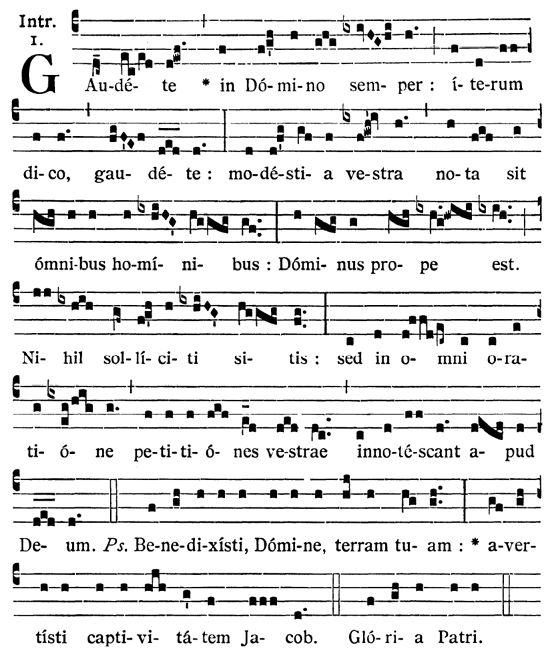
Modestia vestra nota sit hominibus. Dominus prope est.
Nihil solliciti sitis, sed in omni oratione petitiones vestrae innotescant apud Deum.
(Phil 4:4-6)
Benedixisti, Domine, terram tuam. Avertisti captivitatem Jacob.
(Ps 84:2 / 85:1)
Gloria Patri et Filio et Spiritui Sancto.
Sicut erat in principiem, et nunc, et semper, et in saecula saeculorum, amen.
"Rejoice in the Lord always; I say again: Rejoice!"
Lest we forget!
|
Saturday, December 06, 2008
So much sacred music!
In the past month, I have received as gifts a few excellent CDs of sacred music. I'd like to share them with you.
From Branson, for whom I am an RCIA sponsor, I received "Stella Maris" by Trio Mediaeval as a birthday present. This CD has several 12th and 13th century polyphonic pieces (including two odes to the Blessed Virigin Mary) and a contempory polyphonic Mass setting (Missa Lumen de Lumine) by Korean composer Sungji Hong.
From the Benedictines of Mary, Queen of Apostles, I received "Echoes of Ephesus" in the mail. It has two dozen pieces of chant and polyphony (in both English and Latin), including some contemporary pieces. You can definitely detect the devotion of these women -- to God and to sacred music which praises Him and His saints!
And from the Wyoming Catholic College Choir, I received "Christmas In God's Country" in the mail. It has just shy of two dozen pieces of chant and polyphony (in both English and Latin), including one of my recent favorites, Angelus ad Virginem! The choirmaster is none other than Dr. Peter A. Kwasniewski, the author of several articles on sacred music and liturgy ("Aspects of the Liturgical Magisterium", Parts I, II, and III; "Extraordinary Ministers of the Eucharist" [since clarified as "... of Holy Communion"] at EWTN).
Consider purchasing these beautiful CDs of beautiful sacred music. I don't think you'll be disappointed.
From Branson, for whom I am an RCIA sponsor, I received "Stella Maris" by Trio Mediaeval as a birthday present. This CD has several 12th and 13th century polyphonic pieces (including two odes to the Blessed Virigin Mary) and a contempory polyphonic Mass setting (Missa Lumen de Lumine) by Korean composer Sungji Hong.
From the Benedictines of Mary, Queen of Apostles, I received "Echoes of Ephesus" in the mail. It has two dozen pieces of chant and polyphony (in both English and Latin), including some contemporary pieces. You can definitely detect the devotion of these women -- to God and to sacred music which praises Him and His saints!
And from the Wyoming Catholic College Choir, I received "Christmas In God's Country" in the mail. It has just shy of two dozen pieces of chant and polyphony (in both English and Latin), including one of my recent favorites, Angelus ad Virginem! The choirmaster is none other than Dr. Peter A. Kwasniewski, the author of several articles on sacred music and liturgy ("Aspects of the Liturgical Magisterium", Parts I, II, and III; "Extraordinary Ministers of the Eucharist" [since clarified as "... of Holy Communion"] at EWTN).
Consider purchasing these beautiful CDs of beautiful sacred music. I don't think you'll be disappointed.
Thursday, December 04, 2008
Sacred Music in three minutes
Please take the time to watch this video. At least think about what it says!
Monday, August 11, 2008
Music: New directives concerning liturgical music
(Updated for incorrect information regarding dates.)
The Congregation for Divine Worship and the Discipline of the Sacraments, in union with the Congregation for the Doctrine of the Faith, and at the behest of the Holy Father, issued an instruction to Bishops' Conferences at the end of June. Just a few days ago, Bishop Serratelli (Paterson, NJ), the chairman of the US Bishops' Committee on Divine Worship, sent the US bishops s a letter (PDF) regarding the instruction's ramifications and implementation; the PDF also contains the instruction itself.
The Congregation for Divine Worship and the Discipline of the Sacraments, in union with the Congregation for the Doctrine of the Faith, and at the behest of the Holy Father, issued an instruction to Bishops' Conferences at the end of June. Just a few days ago, Bishop Serratelli (Paterson, NJ), the chairman of the US Bishops' Committee on Divine Worship, sent the US bishops s a letter (PDF) regarding the instruction's ramifications and implementation; the PDF also contains the instruction itself.
Friday, May 02, 2008
Personal: Goddaughter receiving First Holy Communion
This weekend, my wife and I are driving ~14 hours (round trip), down to Franklin, VA and back. My God-daughter and niece, Sarah, is receiving her First Holy Communion this Sunday.
What will we listen to in the car? I've got a CD of assorted chant and polyphony from my friend Emily, another CD (O Lux Beatissima) of chant, and I'm thinking of burning a CD of O Fortuna (which I love, and Kristin and I heard performed a couple of months ago); Kristin has a CD of polyphony (by The Orlando Consort).
Hrm, what else...? Perhaps some non-sacred music by Guster (a band Kristin and I both enjoy). And Still Alive from Portal. And a handful of clever songs by Jonathan Coulton.
What would you suggest?
What will we listen to in the car? I've got a CD of assorted chant and polyphony from my friend Emily, another CD (O Lux Beatissima) of chant, and I'm thinking of burning a CD of O Fortuna (which I love, and Kristin and I heard performed a couple of months ago); Kristin has a CD of polyphony (by The Orlando Consort).
Hrm, what else...? Perhaps some non-sacred music by Guster (a band Kristin and I both enjoy). And Still Alive from Portal. And a handful of clever songs by Jonathan Coulton.
What would you suggest?
Subscribe to:
Comments (Atom)