Monday, December 29, 2008

The Mass as Exchange (Part I)


In the Mass, the Church offers proper worship to Holy Trinity through Her prayers, and supremely through the offering of the Eucharist, the sacrifice of the Son to the Father through the Holy Spirit. But we receive something through the Mass as well, and our offering is not simply the Eucharist. At Mass, there is an exchange between heaven and earth, between God and man, and this exchange gives to us the graces necessary to carry out the Church's mission on earth. Through weekly (or even daily) experiences of Pentecost in our own lives, we can be filled with the Holy Spirit.

In this series, we will look at the Mass in detail — in both the Ordinary and Extraordinary Forms — to understand who is coming near to whom, what is being exchanged, and how it is we are equipped for this most important mission: the salvation of souls.

[Note: the "Ordinary Form" (OF) of the Mass is the missal promulgated by Pope Paul VI in 1969 and most recently revised by Pope John Paul II in 2002. The "Extraordinary Form" (EF) of the Mass is the missal promulgated by Blessed Pope John XXIII in 1962, which was a revision of the missal of Pope Pius V from 1570, the so-called "Tridentine" Mass.]

In this first installment, we will look at the Introductory Rites (from the Entrance Procession through to the Collect).

The Sign of the Cross

The Mass begins in the name of the Father, and of the Son, and of the Holy Spirit, as we trace the Sign of Cross over our own bodies. Christ was once placed upon the cross; today we willingly place a sign of that cross upon ourselves. The Lord said to his Apostles, "he who does not take his cross and follow me is not worthy of me" (Matthew 10:38), and then to the crowds who followed him, "Take my yoke upon you, and learn from me; for I am gentle and lowly in heart, and you will find rest for your souls. For my yoke is easy, and my burden is light." (Matthew 11:29-30)

This is the first exchange that takes place in the Mass, and it brings us back some 2000 years. We accept the gentle yoke of Christ and take up our own crosses, all the while proclaiming Christ crucified, as Paul reminded the Church in Corinth. (1 Corinthians 1:23)

Introibo ad altare Dei

Before the Sign of the Cross, however, the priest and other ministers process to the sanctuary. The EF of the Mass uses Psalm 43 (numbered 42 in the Latin Vulgate and the Douay-Rheims), Judica me, to express the spiritual disposition of the priest as he stands at the foot of the altar. The fourth verse of this psalm is used as its antiphon ("anchoring" the psalm at its beginning and end); in Latin, the verse begins : Et introibo ad altare Dei, "And I will go in to the altar of God".

This procession (one of three) is an important part of the liturgy. It reminds us that the Church on earth is a pilgrim on its way to heaven. (GIRM 318) The Mass begins with us approaching the living God: we speak to God, we come to God in prayer.

Penitential Rite and Kyrie

In the EF of the Mass, the Penitential Rite consists of the Confiteor ("I confess to Almighty God...") and a short dialogue. After this comes the Kyrie, which is a triple invocation in Greek: Kyrie eleison means "Lord have mercy" and Christe eleison is "Christ have mercy".

In the OF, this Rite has three forms: 1) the Confiteor, 2) a dialogue based on the one found in the EF, or 3) a set of three invocations combined with the Kyrie. If forms 1 or 2 are used, the Kyrie then follows.

This rite is a necessary prerequisite for offering our prayer and sacrifice of praise to God. (CCC 2631) Of this need for a penitent heart, King David wrote, "The sacrifice acceptable to God is a broken spirit; a broken and contrite heart, O God, you will not despise." (Psalm 51:17) As the priest in the OF introduces the Rite, he reminds us that we must "acknowledge our sins, that we may prepare ourselves to celebrate the sacred mysteries". (Introductory Rites, OM 4)

The Gospel we are to preach contains a message of repentance; St. Mark says that Jesus began his preaching with this message: "The time is fulfilled, and the kingdom of God is at hand; repent, and believe in the gospel." (Mark 1:15) God welcomes us back us the father welcomed back his prodigal son. (Luke 15) Here we receive the first gift of the Mass: the mercy of God. We receive forgiveness for our venial sins, although we still need a sacramental confession to be absolved of mortal sins. This exchange is made possible because of we have accepted the cross of Christ and bear it upon our bodies, as we attest to at the beginning of Mass.

In the words of St. Peter, "He himself bore our sins in his body on the tree, that we might die to sin and live to righteousness." (1 Peter 2:24) St. Paul says the same: "Our Lord Jesus Christ ... gave himself for our sins" (Galatians 1:3-4); and again: "I delivered to you as of first importance what I also received, that Christ died for our sins in accordance with the scriptures." (1 Corinthians 15:3)

Scripture clearly links the crucifixion of Christ to our being forgiven of our sins. By identifying ourselves with Christ through baptism, we are given access to a new life where we can be freed from the slavery of sin (see Romans 6).

Gloria

In response to God's gratuitous forgiveness, we glorify Him with the song of the angels and the ancient hymn of the Church, the Gloria. In return for mercy, we give glory. (Psalm 115:1)

Collect

At the conclusion of the Introductory Rites (and crowning the entrance procession) is the Collect. This prayer (one in the OF, potentially more in the EF) "collects" the intentions of the Mass as well as the private prayers of the faithful; it directs and focuses them on the reason for the celebration of the Mass that day, such as honoring a saint or remembering a particular mystery of the life of Christ.

Summary

In the Introductory Rites, we remind ourselves of Christ's crucifixion, which gives us access to God's mercy and the forgiveness of our sins, the first grace received in the Mass. This mercy is not just a grace for us, but it is part of the gospel we are charged with preaching by the Lord. We are pilgrims on our way to the God who meets us in His Son, Jesus Christ, and in the Father who welcomes back His wayward children: we are told to share this indescribable gift and hope with all the world.

In the next installment, we will look at the Liturgy of the Word (the "Mass of the Catechumens" as it is known in the EF) to continue examining the exchange between God and man, and to see how God responds to our approaching Him.

May the Lord bless us +, protect us from all evil, and bring us to everlasting life. Amen.


Sources:
  • GIRM - General Instruction of the Roman Missal [USCCB]
  • CCC - Catechism of the Catholic Church [The Cross Reference]
  • OM - Ordo Missae I (English Translation) [USCCB]

Sunday, December 28, 2008

Hollywood demonizes the unborn

I used to watch creepy horror movies like The Ring, but not so much anymore. But even if I did, I would be sure to pass up the latest flick, The Unborn. In this gem, a girl's would-be twin (who died in the womb) is haunting her.


I'm sure the movie doesn't have anything to do with abortion; for all I know, the twin died of natural causes. Nevertheless, the screenwriter and the director have succeeded in making the unborn — who are helpless victims of the crime of abortion — into protagonists and aggressors. Thanks, Hollywood. Demonize the unborn; make them victimizers instead of victims.

Saturday, December 27, 2008

The Mass as Mission (Part IV)


The Mass, which is modeled (generally speaking) after Christ's life from Palm Sunday through Ascension Thursday, is an exchange between God and man, between heaven and earth. While the dismissal of Mass corresponds to the Great Commission (and the Lord's subsequent Ascension into Heaven), the whole Mass is, for each of us, an experience of Pentecost.

This encounter with Pentecost is where the Church draws the strength to carry out the mission given to Her by the Lord to preach to all the nations of the world. The primary end of the Mass is to glorify God by rendering proper worship unto the Blessed Trinity by prayers of adoration, petition, contrition, and thanksgiving, culminating in the ultimate prayer and the ultimate sacrifice, the Eucharist: the offering of the Son, through the Holy Spirit, to the Father. But the secondary end of the Mass is the sanctification of God's people, and through them, the world. It is through the sustenance and refreshment which God gives us in the Mass that each of us is able to be a disciple of and witness to the Lord in the world.

Pentecost and the Birth of the Church

More than one event has been called the "birth of the Church". One such incident is the piercing of the side of Christ as he hung lifeless on the cross (John 19:33-34), which corresponds to the forming of Eve from the side of Adam (her spouse) while he slept; but Pentecost also represents the "birth of the Church" because it is here that the Church begins to carry out the mission entrusted to Her by the Lord.

St. Luke, companion of St. Paul, wrote the Acts of the Apostles as a veritable sequel to his gospel, a chronicle the early years of the Church. He records for us the miraculous intervention of the Holy Spirit on Pentecost, a Jewish feast day held 50 days after the sabbath following the Passover. (Leviticus 23:15-16) At the time, the Apostles were praying in Jerusalem along with Mary the mother of Jesus and other kin of the Lord and the other women who had followed him. (Acts 1:12-14) After the first novena — nine days of prayer starting on the day after the Ascension to that Sunday of the Pentecost — the Holy Spirit manifested himself to them in the form of tongues of fire. After this, they began to prophesy and St. Peter preached his first sermon, calling for the faithful Jews who had come to Jerusalem on pilgrimage to repent and be baptized into Christ. (Acts 2)

The Church, born from the side of Christ, now took her first breath, a divine breath, the breath of God, the Holy Spirit. It was on Pentecost that the mission began to be lived, and as soon as this mission had been commenced, the new disciples of Christ "devoted themselves to the Apostles' teaching and fellowship, to the breaking of bread and the prayers". (Acts 2:42)

An Exchange Between God and Man

The Mass, by God's grace, gives us what we need to fulfill His will for us on earth. Receiving the Real Presence of our Lord in the Most Blessed Sacrament when we receive Holy Communion is not the only thing we "get" out of Mass, and we put far more into it than we might imagine. Over the next several installments (under the title "The Mass as Exchange") we will examine each part of the Mass to see what "exchange" is made between God and man, always using Pentecost as our point of reference. Every grace and blessing which the newborn Church received to carry out Her mission is made present for us at every Mass. This perspective, whereby the Mass is our personal Pentecost, will help us to understand the Mass as mission and prepare us for living that mission daily.

May the Lord bless us +, protect us from all evil, and bring us to everlasting life. Amen.

Friday, December 26, 2008

Merry (and Hectic) Christmas

Merry Christmas to all my readers!

After news of my promotion and end-of-the-year award, things went haywire. On Sunday evening, the air conditioning units in my office's server room stopped working (so the servers basked in 100+ temperatures until Monday). On Tuesday, a critical database server went down and did not reboot properly; I worked until 9:15 that evening. On Wednesday, we were still in server-cleanup mode (since the other developer, who knows far more about system administration and hardware than I do) was on vacation (and otherwise incapacitated, having gone through sinus surgery that morning).

Christmas Eve dinner was held at my brother's house in Morris County -- pirogis and oplatky (the Slovak traditions from my mother's side) and shrimp.

Christmas morning, my wife and I exchanged gifts (more on those later), went to 9:00 AM Mass -- and knelt during the "By the power of the Holy Spirit..." in the Creed (genua flectunt, "they bend the knees", GIRM 137) -- and then drove up to her parents' place where we stayed until Friday afternoon. I brought my laptop (because I knew work would have to be done at some point).

At around 10:30 that evening, I did a bit of work, and made an error that ground the web server to a halt. So at 11:45 PM on Christmas, I drove down from Rutherford (near Giants' Stadium) to Princeton to fix a server issue that I could not repair remotely and which I did not feel justified in asking someone else to take care of at such a late hour and which could not wait until the morning. I got back to Rutherford around 2:30 am on Friday. I calmed myself on the drive down with a Rosary and prayed the Divine Mercy Chaplet on the way back in thanksgiving for a smooth resolution to my stupid programming error. (Programmers: remember to properly terminate your forked processes. Spawning 2**27 - 1 processes on the web server is never a wise move.)

Now, at the close of Friday, my wife and I are back in Princeton. Tonight, we're playing a game I bought her and watching a DVD she bought me. (Presents in a minute...)

Tomorrow, we're going into Newark to see Video Games Live (performed by the NJ Symphony Orchestra) with a few friends. Sunday, after Mass, we're watching the last NY Giants game of the regular season. And relaxing.

Presents! Among other things, my wife gave me the 5-disc NY Giants Superbowl Champions DVD box set and some much-needed clothes; she also gave me a book by Eamon Duffy, "Faith of our Fathers", which is his personal reflection on traditional Catholicism... I can't wait to read it! Some of the gifts I gave her were a cute card game called Guillotine (which we've played before) and a 12" x 16" Annunciation by Fra Angelico (pictured at right).
With the money I received from my in-laws, I bought a peacoat, a collared shirt, and a brown vest. I also received a full pajama set and a pair of slacks from Kristin's parents. So now I'm going to try some clothing on and end up in my new pajamas to cuddle up by the fireplace with Kristin and play some Guillotine and relive football memories from a year ago!

Merry Christmas!

Friday, December 19, 2008

Personal: Good news!

At my company's Christmas party, I was told ahead of time that I would be receiving a promotion (from Junior Developer to Senior Developer). I was not told that I was also to be the recipient of the annual Chairman's award! That was a pleasant surprise!

The Mass as Mission (Part III)


The mission of the Church is nothing other than the mission of Jesus Christ. The Church's mission is as much a part of her life during the Mass as it is outside the Mass. In order to understand how the mission of Jesus (which becomes our mission) is related to the Mass, let us interpret the parts of the Mass as if they were the events at the end of the earthly life of Jesus as recorded primarily in the Gospel according to Matthew.

1a. Jesus enters Jerusalem (Matthew 21:1-11)

On what we now commemorate as Palm Sunday, Jesus entered into Jerusalem humbly but triumphantly: while he rode upon an ass, a beast of burden, the crowd that gathered to great him spread their garments before him and waved palm branches while singing from Psalm 118:25-26, "Hosanna! Blessed is he who comes in the name of the LORD!"

1b. The Entrance Procession

As the Mass begins, the priest approaches the altar, a symbol of the altar before God in the heavenly temple, the celestial Jerusalem. The priest, by the sacrament of Holy Orders he has received, is in persona Christi — in the person of Christ — as he prays the Mass and ultimately consecrates and offers to God the Father the sacrifice of the Eucharist. As the priest enters, the church sings as the people of Jerusalem did.

The significance of an entrance procession — rather than the priest simply being in the sanctuary at the beginning of Mass — is that the Christian life is a continuing journey: it is not complete yet; we are still walking with our Lord. It is a sign of the pilgrimage we are all making to the true sanctuary, the Holy of Holies where the heavenly hosts praise God without ceasing. (Revelation 4:8)

2a. The Cleansing of the Temple (Matthew 21:12-17)

What Jesus did next greatly disturbed many people, such as the chief priests and the scribes. Jesus drove out the people doing business in the temple, overturning the tables of the money-changers and the seats of those who sold the animals for the sacrifices. Why?
Jesus came to Jerusalem just before the Passover, when many animals would be sacrificed according to the Mosaic Law (mostly lambs). Animals offered in sacrifice had to be flawless, the best you could offer. That meant that a Jew who was making a pilgrimage to Jerusalem from a distance would most likely have to buy his animals in Jerusalem, since any livestock he brought with him on his pilgrimage would get dirty along the way, diminishing its worthiness for sacrifice. So there would be people selling animals in the temple area. However, the temple had its own system of currency: since Jews from all over the region would come, bringing foreign currencies with them, they would convert their money into the temple currency and then buy their animals. But the money-changers operated at an unfair exchange rate.
What justification did Jesus use for this act? He quotes Isaiah 56:7 to them — "My house shall be called a house of prayer" — and then laments that they "make it a den of robbers". (Matthew 21:13) John's gospel records the disciples as remembering afterwards what was written in the Psalms: "Zeal for thy house will consume me." (Psalm 69:9)

Matthew also records that after Jesus had done this, "the blind and the lame came to him in the temple, and he healed them". (Matthew 21:14) When does all this happen at Mass?

2b. The Penitential Rite

The business of the temple in Jerusalem was disrupted by Jesus, and four decades later it was destroyed. But even before its destruction the temple was becoming obsolete. Paul, in writing to the Corinthians, reminds them of the great responsibility they have as men and women baptized into Christ:
Do you not know that you are God's temple and that God's Spirit dwells in you? ... Do you not know that your body is a temple of the Holy Spirit within you, which you have from God? You are not your own; you were bought with a price. So glorify God in your body. (1 Cor 3:16; 6:19-20)

For we are the temple of the living God; as God said, "I will live in them and move among them..." (2 Cor 6:16)
The priest introduces the Penitential Rite with these words: "Brethren, let us acknowledge our sins, that we may prepare ourselves to celebrate the sacred mysteries." (OM 4) When we acknowledge our sins before God, we ask Him to forgive them and cleanse us of them.

Our bodies should be houses of prayer, but we have made them dens for thieves. Sin does not belong in the temple. Every sin we commit is an act of profanation. The word "profane" comes from the Latin profano which means "outside the temple"; something which is "profane" is not proper to -- does not belong in -- the temple. The "profane" is the opposite of the "sacred".

It is in this Penitential Rite, when we make a general confession of our sins (which does not take the place of the sacrament of Confession), that Jesus comes to his temple -- your body -- and drives out that which dirties and profanes it. And in that same moment, he heals and cures us, he makes us whole again. He repairs these fragile temples, and makes us fitting temples for his Holy Spirit once more. It is only then that we are prepared to participate in the sacred mysteries, the Holy Sacrifice of the Mass, and to offer ourselves as living sacrifices as well.

3a. Jesus Preaches and Teaches (Matthew 21:18-25:46)

Over the next several days, Jesus was in Jerusalem preaching and teaching. He used parables and interpreted the Scriptures — writings of the prophets, the Psalms of David, and even the Torah of Moses — for people, especially Sadduccees and Pharisees. He spoke of the future, the tribulation to come, and the return of the King of Kings at the end of the world.

3b. The Liturgy of the Word

As Scripture is read to you, and as the priest or deacon reads the Gospel and conveys to you the truths of the faith in the homily, you are encountering the continuation of Christ's ministry. The Old Testament is explained and revealed in the New, as so many Church Fathers (such as St. Augustine) loved to say.

4a. His Passion, Death, and Resurrection (Matthew 26:1-28:10)

Next came the three most important days of Christ's work on earth: the institution of the Eucharist at the Last Supper (and the institution of the ministerial priesthood), the agony in Gethsemane, his sorrowful Passion — being put on trial, scourged, humiliated, condemned to die, and crowned with thorns, followed by his march to Calvary —, his crucifixion and death, his burial, the day of silence in the tomb, and his glorious Resurrection.

At the Last Supper, when Christ inaugurated the new and everlasting covenant in his blood, he made it clear why he was doing what he was doing, and just what it was exactly he was doing. He said that the bread and the wine was his body and blood (and not just a symbol of it), and he said that his blood was being poured out "for many for the forgiveness of sins" (Matthew 26:28).

4b. The Liturgy of the Eucharist

From the evening of Holy Thursday through to the evening of Easter Sunday, the Church celebrates the Paschal Triduum, the "three days of Easter". These days commemorate the events listed above. We encounter them altogether in the Liturgy of the Eucharist. It is most important to remember that in the Eucharistic Prayer, when the priest, in virtue of the holy ordination he received, calls upon the Holy Spirit and recites the words of Jesus Christ, the bread and the wine change in substance (transubstantiate) into the Body, Blood, Soul, and Divinity of our Lord Jesus Christ. This change is not apparent to our senses, but then again, neither is the change we undergo in baptism.

After the consecration, the bread and wine have become the Eucharist. Immediately afterwards, in the Eucharistic Prayer, the priest offers the Eucharist to God the Father. In doing so, he is re-presenting the sacrifice of Christ, the same sacrifice Christ pre-presented to the Father at the Last Supper and presented bodily on the cross. Pay close attention to the language he uses:
Therefore, O Lord, as we celebrate the memorial of the saving Passion of your Son, his wondrous Resurrection and Ascension into heaven, and as we look forward to his second coming, we offer you in thanksgiving this holy and living sacrifice.

Look, we pray, upon the oblation of your Church and, recognizing the sacrificial Victim by whose death you willed to reconcile us to yourself, grant that we, who are nourished by the Body and Blood of your Son and filled with his Holy Spirit, may become one body, one spirit in Christ. (Eucharistic Prayer III, OM 113)
When we receive Holy Communion — and we should only do so if we have confessed any and all mortal sins we have committed since our last confession, have fasted for an hour, and are not otherwise prohibited from receiving — we are blessed to receive our Lord as food. But this is not a "fraternal meal", it is the Most Blessed Sacrament, because it contains the Author of all the graces we can receive. This is, as the priest says, "the Lamb of God ... who takes away the sins of the world", and we are partaking in "the [marriage] supper of the Lamb". (The Communion Rite, OM 132; cf. John 1:29; Revelation 19:9)

While John's gospel does not record the institution of the Eucharist, John 17 reads as a form of "Eucharistic Prayer" (a prayer of thanksgiving and glorifying God).

5a. His Ascension into Heaven (Matthew 28:16-20)

After his resurrection, Jesus called the apostles together on a mountain in Galilee (Matthew 28:16) and gave them the greatest charge of all. "Go therefore and make disciples of all nations, baptizing them in the name of the Father and of the Son and of the Holy Spirit, teaching them to observe all that I have commanded you; and lo, I am with you always, to the close of the age." (Matthew 28:19-20) This mission, which had been and continues to be Christ's, he gave to his Apostles, to the Church.

Some time after he gave them this commission, he blessed them as he ascended into heaven from the Mount of Olives, as Luke's writings attest to. (Luke 24:50-53; Acts 1:7-13)

5b. The Dismissal

The priest blesses us in the name of the Most Holy Trinity at the end of Mass, and then follows the dismissal. When we hear the words "Ite, missa est", we are hearing the words of Christ to his disciples: "Go, I am sending you into the world to continue my mission." The dismissal of the Mass is our entering into (and accepting of) the Great Commission before the Lord's glorious Ascension into heaven.

Conclusion

Now we can see how the mission of Christ has become the mission of the Church, and how, just as the Eucharist is the re-presentation of the sacrifice of Jesus Christ, the dismissal of the Mass is the re-presentation of that Great Commission whereby the Church was formally invested with that charge.

How can the Church, how can we today carry on so great and serious a mission? What is our sustenance? Whence do we draw our strength? Where do we find refreshment? To answer those questions, we need look no further than the Mass itself; for in the Mass, the first and most important end of which is the glorification and proper worship of God, God gives us the grace needed to fulfill this mission.

We have seen how the Mass follows the model of Christ's life from Palm Sunday through Ascension Thursday. We will see how the Mass is a conversation, a dialog, an exchange between God and man, between heaven and earth; we will see how in every Mass, we experience Pentecost in our own lives... in the next installment.

May the Lord bless us +, protect us from all evil, and bring us to everlasting life. Amen.


Sources:
  • OM - Ordo Missae I (English Translation) [USCCB]

Wednesday, December 17, 2008

Two EWTN Programs

Early this evening at 8pm, Bishop Athanasius Schneider of Kazakhstan was on EWTN Live. (I missed it, but I'll watch the re-airing of it tomorrow morning at 9am.) Bishop Schneider is the author of Dominus Est ("It is the Lord!") and supports the traditional Latin practice of receiving Communion on the tongue while kneeling.

And coming on in a few minutes (but re-airing at 5am) is the Maronite Divine Liturgy from the Eparchy of Our Lady of Lebanon (in St. Louis, Missouri).

You can watch these and other fine programs via EWTN's online video stream.

The Mass as Mission (Part II)


In order to understand the Church's mission, we must first understand Jesus' mission. What is his mission? And who gave it to him?

The Gospel of John makes the mission of Jesus quite clear: "For God so loved the world that he gave his only Son, that whoever believes in him should not perish but have eternal life. For God sent the Son into the world, not to condemn the world, but that the world might be saved through him." (John 3:16-17) The very name of Jesus means "YHWH saves" or "YHWH is salvation", and the angel told Joseph that Jesus "will save his people from their sins." (Matthew 1:21)

Jesus tells us who gave him this mission: "For I have come down from heaven, not to do my own will, but the will of him who sent me." (John 6:38)

In John's gospel, the word "send" or "sent" is used 50 times in conjunction with the Father sending the Son, or the Son sending the Holy Spirit or his disciples. Jesus worked great miracles (such as the raising of Lazarus from the dead in John 11) that the Jews to whom he ministered would believe that God had truly sent him. God the Father sent His Son into the world, "that the world might be saved through him". (John 3:17) So the mission of the Lord pertains to the salvation of those who receive him. But salvation from what?

Luke's gospel gives us additional information about the Lord's mission. Soon after Jesus began his ministry, he went to the synagogue in Nazareth and read from the Scriptures: "The Spirit of the Lord is upon me, because he has anointed me to preach good news to the poor. He has sent me to proclaim release to the captives and recovering of sight to the blind, to set at liberty those who are oppressed, to proclaim the acceptable year of the Lord." (Luke 4:18-19) Jesus was anointed by God as the Christ (the Messiah, which means "the anointed one") to preach the gospel ("good news").

Who are the poor? Who are the captives, the blind, and the oppressed? Is the release and sight and liberty which Jesus brings purely a social or physical gift? Jesus restored the sight to many who were blind and cured all kinds of illnesses, but the depth of his mission goes far deeper. When he instituted the greatest of all sacraments, the Eucharist, Jesus said that the cup he gave to them to drink was the "the new covenant in my blood" (Luke 22:20); Matthew records the purpose of that covenant: "[it] is poured out for many for the forgiveness of sins." (Matthew 26:28)

Matthew ends with the "Great Commission", where the Lord says to his disciples: "All authority in heaven and on earth has been given to me. Go therefore and make disciples of all nations, baptizing them in the name of the Father and of the Son and of the Holy Spirit, teaching them to observe all that I have commanded you; and lo, I am with you always, to the close of the age." (Matthew 28:18-20) To receive a "commission" is to be entrusted with something.

So Jesus sent his disciples out to all nations. He assured them of his presence with them, and he gave this promise to them (and to those to whom he sent them): "he who receives any one whom I send receives me; and he who receives me receives him who sent me." (John 13:20) Jesus identified the sending of his disciples with his own being sent by the Father: "As the Father has sent me, even so I send you." (John 20:21) Jesus also made it clear why he was sending them: "I chose you and appointed you that you should go and bear fruit and that your fruit should abide." (John 15:16)

Jesus sends the Church, he sends us, into the world for the same reason that the Father sent him. And the Church wasted no time! Just read the first two chapters of the Acts of the Apostles! The mission of the Church, then, is nothing other than the mission of Jesus Christ. But what does this have to do with the Mass? We'll cover that in the next installment.

May the Lord bless us +, protect us from all evil, and bring us to everlasting life. Amen.

Critical Mass: "The Mass as Mission"

What is Critical Mass? From the "About" page:

critical mass (n) - the smallest amount of fissile material needed for a sustained nuclear chain reaction

critical (adj) - characterized by careful, exact evaluation and judgment; indispensable, essential

Mass (n) - public celebration of the Eucharist in the Western Rites of the Catholic Church
Critical Mass is a blog devoted to the liturgical catechesis of the faithful of the Catholic Church called for by Vatican Council II in its first document, the Constitution on the Sacred Liturgy, Sacrosanctum Concilium:
With zeal and patience, pastors of souls must promote the liturgical instruction of the faithful, and also their active participation in the liturgy both internally and externally... [n. 19]

So that's what Critical Mass is. The first content is already up: Part I and Part II of the series called "The Mass as Mission".

Tuesday, December 16, 2008

Bible Study: 4th Sunday of Advent

1 Thess 5:16-24
The mystery of God’s plan is finally revealed
Soli sapienti Deo per Iesum Christum, cui gloria in saecula!
Download this study [MS Word, 49 k, 2pp]

O Come, Let Us Adore Him (resources)

Recently, I gave a presentation on Eucharistic Adoration at my parish. If you would to download the text of that presentation or the pamphlet I produced to accompany it, here are the links:

My Talk [100 K Word Document]
Pamphlet [84 K Word Document]

I might make an audio recording as well.

The Mass as Mission (Part I)

"Ite, missa est!" "Deo gratias."

For around 1500 years, this is what Western Catholics heard at the conclusion of the Mass. You can still hear it today in some churches where Latin is employed in the Mass, at least from time to time. (You will also hear it if you attend the Extraordinary Form of the Mass, the Mass as celebrated in 1962.)

The response is easy enough to understand: "Thanks be to God!" Despite what you might hear in jokes or how you might feel sometimes, we're not saying "Thanks be to God [that Mass is finally over]." But we do need to know why we're thanking God. So what does "Ite, missa est!" mean? It's especially important to know, since the word "Mass" comes from this Latin word missa.

The word missa is a form of the word missio, which means "dismissal" in its original context. It was said to the catechumens (those who are preparing for baptism) just before they were dismissed at the end of the first half of the liturgy (the "Mass of the Catechumens", now known as the "Liturgy of the Word"); it was also said to the faithful at the end of the second half of the liturgy (the "Mass of the Faithful", now known as the "Liturgy of the Eucharist").

However, the word missio also means "sending" or "mission". With missio as with many other Latin words ending in "-io" — congregatio, ascensio, religio — the English equivalent is produced simply by adding an "n" to the end — congregation, ascension, religion.

A completely literal translation of "ite, missa est" is "Go, it is the dismissal"; but the phrase means more than that. In the forthcoming translation of the Roman Missal (the book from which the priest prays the Mass), the translation is "Go forth, the Mass is ended". (The Concluding Rites, OM 144) Along with this dismissal, the Church is preparing three variants:
  • "Ite ad Evangelium Domini annuntiandum" ("Go and announce the Gospel of the Lord")
  • "Ite in pace, glorificando vita vestra Dominum" ("Go in peace, glorifying the Lord by your life")
  • "Ite in pace" ("Go in peace")
While the purpose of these additional texts is to emphasize the missionary character of the dismissal (and the Mass in general), the original dismissal text can still be used (whether in Latin or the approved vernacular translation). The problem these texts are trying to solve is that many Catholics do not know about this missionary character. As an alternative solution to using the new texts, proper catechesis of the faithful as to what the original words really mean will enlighten the members of the Church to understand what the mission of the Church is and how that mission belongs to each one of them as well.

So while pragmatically speaking the priest (or deacon) is letting the people know that the liturgy has ended and they are dismissed, there is a far deeper meaning to these words. Pope Benedict XVI spoke to this point in his 2007 Post-Synodal Apostolic Exhortation Sacramentum Caritatis:
These words help us to grasp the relationship between the Mass just celebrated and the mission of Christians in the world. In antiquity, missa simply meant "dismissal." However in Christian usage it gradually took on a deeper meaning. The word "dismissal" has come to imply a "mission." These few words succinctly express the missionary nature of the Church. The People of God might be helped to understand more clearly this essential dimension of the Church's life, taking the dismissal as a starting-point. (n. 51)
So what is the missionary nature of the Church? In order to understand the Church's mission, we must first understand Jesus' mission. And we'll cover that in the next installment.

May the Lord bless us +, protect us from all evil, and bring us to everlasting life. Amen.


Sources:
  • "Sacrifice of the Mass", Catholic Encyclopedia [New Advent]
  • OM - Ordo Missae I (English Translation) [USCCB]
  • Sacramentum Caritatis (The Sacrament of Charity), Pope Benedict XVI [Vatican]

Monday, December 15, 2008

Liturgy: Catechesis on the Ordinary Form of the Roman Rite

Update: I changed the domain name of the new blog from 'the-liturgy.blogspot.com' to 'romanliturgy.blogspot.com'.

I'm going to be providing a series of posts on the individual parts of the Mass (in the Ordinary Form) at a new blog called Critical Mass. (I'm a sucker for puns.)

There's nothing there yet, but there will be.

I won't be cross-posting (duplicating) the content from Critical Mass here, but I will post links here when new content appears there.

Theology: The Holy Spirit is Love

I'm reading Pope Leo XIII's encyclical on the Holy Spirit, Divinum Illud Munus. He mentions half a dozen times that the Holy Spirit is the Divine Love between the Father and the Son; i.e., that the Holy Spirit is the Person of Love.

Even more, it contains some interesting historical and liturgical information about the Blessed Trinity:
Our predecessor Innocent XII, absolutely refused the petition of those who desired a special festival in honor of God the Father. For, although the separate mysteries connected with the Incarnate Word are celebrated on certain fixed days, yet there is no special feast on which the Word is honored according to His Divine Nature alone. And even the Feast of Pentecost was instituted in the earliest times, not simply to honor the Holy Ghost in Himself, but to commemorate His coming, or His external mission. And all this has been wisely ordained, lest from distinguishing the Persons men should be led to distinguish the Divine Essence. Moreover the Church, in order to preserve in her children the purity of faith, instituted the Feast of the Most Holy Trinity... (Divinum Illud Munus, n. 3)

Sunday, December 14, 2008

Liturgy: The Extraordinary Form of the Mass in the Metuchen Diocese

This comes via Fr. Z's blog, What Does the Prayer Really Say?
[I]n the Diocese of Metuchen, NJ we have a shrine chapel where TLM has gone from once a month to every day! The former St. Bernard parish church in Raritan, NJ was no longer used because the parish moved to a bigger piece of property and a larger church. The diocese turned the church into the Shrine Chapel of the Most Blessed Sacrament for daily all-day adoration and Confessions. It has served in the capacity for over a decade now.

Every day mass is celebrated in the morning in the Novus Ordo (in English and Latin ad orientem) and then the Blessed Sacrament is exposed. There are Confessions heard every day. Each evening there is Benediction of the Blessed Sacrament at 6:45pm followed by TLM at 7:00pm. On Sundays TLM is celebrated at 11:00am and there is Benediction in the afternoon. The bishop has also given his permission for those who request it to have other Sacraments (like Baptism) celebrated at the Shrine in the extraordinary form and to have funerals there if they desire to have a funeral in the extraordinary form. It is not a parish church but it is a sort of "quasi-parish".
I will need to find the time to attend Mass there (in both the Ordinary and Extraordinary Forms).

View Larger Map

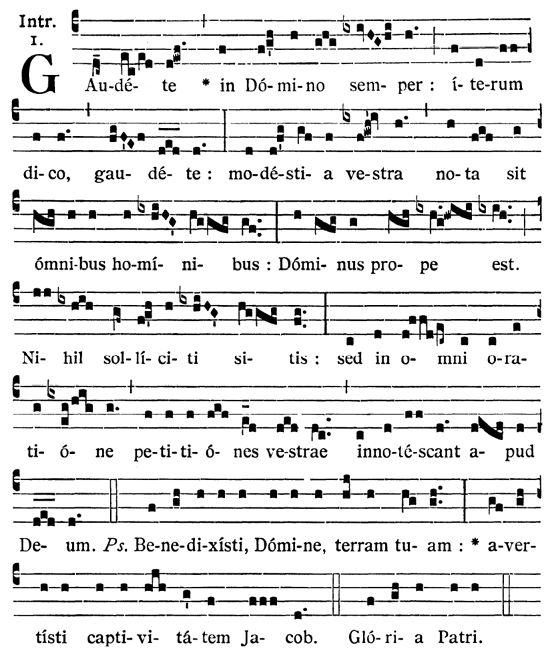
Music: Gaudete introit for the 3rd Sunday of Advent

Gaudete in Domino semper; iterum dico: Gaudete!
Modestia vestra nota sit hominibus. Dominus prope est.
Nihil solliciti sitis, sed in omni oratione petitiones vestrae innotescant apud Deum.
(Phil 4:4-6)

Benedixisti, Domine, terram tuam. Avertisti captivitatem Jacob.
(Ps 84:2 / 85:1)

Gloria Patri et Filio et Spiritui Sancto.
Sicut erat in principiem, et nunc, et semper, et in saecula saeculorum, amen.

"Rejoice in the Lord always; I say again: Rejoice!"

Lest we forget!

Get this widget | Track details | eSnips Social DNA

Saturday, December 13, 2008

Liturgy: People of the Ottawa archdiocese take a stand against kneeling

The Archbishop of Ottawa, Canada -- His Excellency Terrence Prendergast -- has addressed the souls under his care with a pastoral letter (PDF) on November 23rd in preparation for the new liturgical year. Here is most of the text of that letter (bracketed parts are in the original, emphasis is mine):
The beginning of a new liturgical year is regularly the occasion for modifications in liturgical practice. This year, I invite all the faithful to adopt a common practice at Mass -- that of kneeling from the end of the "Holy, holy, holy" and standing after the consecration when the celebrants invites the congregation to proclaim "the mystery of faith".

[Exceptions to this rule are permitted for Masses in schools, nursing homes and similar circumstances where other appropriate postures may be determined; parish churches without kneelers are granted an extension of their current practice for a year, or until other provisions are agreed upon with the Chancery.]

In my visitation of other parishes, I have noted a wide range of practices, which have been legitimately introduced but which, overall, present a lack of harmony in matter in which we should be united -- the worship of God. The practice I am mandating for the Archdiocese is one of the Bishops of Canada have determined will be normative in our country once the Third Edition of the General Instruction of the Roman Missal (GIRM3) is implemented in the near future.

[In dioceses where the custom has been to kneel throughout the Eucharistic Prayer "this practice may laudably be retained" (GIRM3:42-44).]

Posture in prayer may take the form of standing, expressing our dignity before God as His children set free by the death and resurrection of Christ -- as is the case in much of the Mass -- or by kneeling, to express adoration and reverence, which is appropriate at the consecration of the Mass. This common practice for our Church of Ottawa will allow us to manifest both postures during the Great Eucharistic Prayer of Praise.

I shared my intention to implement this new policy with our clergy in late August and I know that it may not be easy for some to accept. However, I am convinced its implementation will bring blessings to our Archdiocese and I invite your cooperation with this directive.
Some people are not taking it well. Two newspaper articles (here and here) paint a pretty sad picture. The first article reports that "[s]ome expressed concerns that the archdiocesan liturgical commission was not consulted." No offense to liturgical commissions, but the buck doesn't stop with them, it stops with the bishop, the one who has actual eccesial authority, the moderator of the liturgy for his diocese.

The Second Vatican Council (Sacrosanctum Concilium) had this to say about liturgical commissions (first for episcopal conferences, second for dioceses):
44. It is desirable that the competent territorial ecclesiastical authority ... set up a liturgical commission, to be assisted by experts in liturgical science, sacred music, art and pastoral practice. So far as possible the commission should be aided by some kind of Institute for Pastoral Liturgy, consisting of persons who are eminent in these matters, and including laymen as circumstances suggest. Under the direction of the above-mentioned territorial ecclesiastical authority the commission is to regulate pastoral-liturgical action throughout the territory, and to promote studies and necessary experiments whenever there is question of adaptations to be proposed to the Apostolic See.

45. For the same reason every diocese is to have a commission on the sacred liturgy under the direction of the bishop, for promoting the liturgical apostolate.
The commission is supposed to have experts, eminent persons, in the fields of liturgy, sacred music, art, and pastoral practice. Experts, yes, but with the humility to operate "under the direction of the bishop". Inter Oecumenici 47 described the function of a diocesan liturgical commission in more detail.

As for the General Instruction of the Roman Missal, it only mentions the liturgical commission in the context of construction or redesign of buildings: "The Diocesan Bishop ... should use the counsel and help of this commission whenever it comes to laying down norms on [the proper construction, restoration, and remodeling of sacred buildings], approving plans for new buildings, and making decisions on the more important issues." (GIRM 291)

The first article ends this way:
Others objected to the focus on a liturgical change when the Church faces other problems. Parishioner Toddy Kehoe told the Citizen, “Is that all they have to think about? I don’t see the Catholic Church as doing loving things. “I don’t see them as the caring community they should be. It isn’t whether you stand or kneel.”
Perhaps Toddy forgets that he too is part of the Catholic Church and, while his purview may not include liturgical decisions, it does include "doing loving things" and building a "caring community". He also speaks as though the Church can only handle one thing at a time, as if the Ottawa diocese was expending all its energy and resources towards this monumental change of posture. One thing is certain: he fails to see the connection between our liturgical attitude and our missionary life outside of Mass.

The second article goes into greater detail:
In an interview later, he explained: "It's a sign of reverence. People say, 'I don't like that. We are the people set free, we no longer have to kneel to God,' and I said, 'Wait a minute, we do have to kneel to God. Christ knelt in the garden. People knelt before Jesus. Why can't we do that for a few minutes at mass?' "One woman told him her husband might not come to church because of this. "She said, 'we French Canadians have a bit of an inferiority complex. We don't like people telling us what to do'."
How ever do these French Canadians get along with God?
St. Joseph's Rev. Richard Kelly declined to comment, as did a staff member who said in an e-mail: "It is hard to believe that a kneeler is such a big topic, and I wish I could say something about this piece of furniture that was meaningful, and about the prayer posture we have been requested to assume, but we are in difficult times and the focus for us as a parish is really how can we participate in the truth and reconciliation process with the aboriginal community of Canada."
"Reconciliation" and "kneeling" seem to be strongly connected in my mind. How many scenes in the gospels do people come to Jesus and kneel or fall before him, asking to be forgiven, for mercy?

The Archbishop gets to the heart of the matter:
"Every time you talk about liturgy, everything else going on in the church is reflected." Right now, the Catholic church is asking, "Is (the mass) our thing or is it God's thing? There are certain tensions in the church about that. After 40 years since the Vatican Council, we have gotten away from certain aspects of reverence; we're trying to have more harmony and co-ordination. Harmony will help bolster a sense of divine worship, something that has slipped away. What has happened with the liturgy is that it is being asked to bear too many things."

At one mass, people got so enthusiastic about greeting each other at the exchange of the peace that it took 45 minutes to get back to the pews and resume the service. "That's not what mass is about. It's about worshipping God ... At one time, nobody ever applauded. Now, they applaud for everything. It becomes more like a concert."

As to his authoritarian message, he said, "The bishop is the mentor of the liturgy, moderator, the one who calls the shots. I try to do it gently." Nevertheless, to both clergy and congregants, he says, "I know you disagree, but I would like you to come along." If someone comes to church and stubbornly stands, they won't be asked to leave. But, the archbishop says, "You sort of wonder, what are they proving when there are two people standing in a church of 500 kneeling? Some people always have to let you know they're right."
I applaud the Archbishop for trying to bring unity to his archdiocese, recovering a sense of the sacred, and supporting his stance with Scripture and Tradition!

Friday, December 12, 2008

Mass in the Extraordinary Form in Yardville, NJ on December 31

From Brian, by way of Fr. Z:
[T]hrough the good graces of Fr. Edward Kelty, celebrant and Fr. Stanley Krzyston, Pastor, a Low Mass in the Extraordinary Form will be celebrated (as of now) at 11AM on the 31st of December at St. Vincent dePaul parish in Yardville NJ. As of now, yours truly [Brian] will serve as one of the acolytes along with another member of our weekly rosary group.

Fr. Kelty is a degreed Canon Lawyer assigned to the Apostolic Signatura in Rome at the present time, but will be home visiting family during Christmas.
Yardville is only a half hour from Princeton, so I expect to be in attendance.


View Larger Map

Avery Cardinal Dulles, R.I.P.

Avery Cardinal Dulles, S.J., has died at the age of 90.

Requiem aeternam dona ei Domine, et lux perpetua luceat ei.

Thursday, December 11, 2008

Catholic Q&A with teenagers

As I hope you've all figured out by now, I lead a Bible study for young adults (20s and 30s) at a nearby parish. Two of the members of the study are the leaders of a Bible study at that same parish for teenagers. I've been invited to their next meeting:
Hey Jeff, hope you're doing well. Next Thursday night, we are going to have a question and answer session with the teen bible study and Nicole and I thought it might be a good idea to invite you since you always have some great facts to share. Some of their questions are in regards to:

Evolution
Reconciliation (Won't God forgive our sins if we ask)
Eucharist (Is it really Jesus or not)
Why Priests can't marry
History of the Church and corruption

and other various things about the Catholic church.
I plan on brushing up on my Catechism, and bringing along my Bible, Catechism, Compendium of the Catechism, and even Pope Benedict's recent book The Fathers. Maybe a few other resources as well. The topics listed are answerable from a Scriptural, historical, and Catechism-al approach: Scripture supports it, the history of the Church has verified and confirmed it, and the Catechism teaches it. (As for evolution, which is not mentioned in the Catechism at all, I'll take a different approach, pointing out that while Genesis 1-11 is a "certain type of history", there are some particular things we must believe from it -- e.g., the special creation of man and woman -- and certain things which are not required to be believed -- e.g., whether the "day" was a 24-hour day.)

But I'm interested in knowing how you'd approach these topics. Remember, my audience is teenagers. I'm 27 now, probably at least 10 years removed from them. (You there, reading my blog in an un-assuming manner... I'm asking you!)